
The HSN, TSN, and KBA numbers allow you to determine the manufacturer, model, and engine type of your car or vehicle. You can store and analyze this data in the vehicle management section of the CATAMA software . Below, you'll find detailed information about the HSN and TSN codes and where to find this information. CATAMA also includes a KBA search function to simplify vehicle setup.

KBA – Federal Motor Transport Authority Number
The KBA number is a combination of the HSN and TSN. The Federal Motor Transport Authority (KBA) provides a complete list of manufacturer key numbers on its website. Multiple HSN assignments for the same manufacturer are possible, usually resulting from restructuring or company name changes.
HSN – Manufacturer's Key Number
The manufacturer's key number (HSN) is a four-digit numerical code. It uniquely identifies the vehicle's manufacturer. The key number is located in Part I of the vehicle registration certificate under point 2.1. For older vehicle registration certificates – issued before September 30, 2005 – the manufacturer's key number is found in field 2. The manufacturer's key number (HSN) is generally maintained by the Federal Motor Transport Authority (KBA) in Flensburg, which is subordinate to the Federal Ministry of Transport and Digital Infrastructure.
By combining the HSN and TSN (see type key number), a vehicle can be uniquely identified and classified. The data can be easily entered into CATAMA software and is also searchable.
Key facts about the manufacturer's key number (HSN)
The HSN consists of a four-digit number sequence and is recorded in the vehicle registration document.
On a new vehicle registration certificate (Part 1), the HSN code is located in field 2.1. For a vehicle manufactured before 2005, the manufacturer's key number is simply entered in field 2. The same applies to the vehicle title (Part 2).
TSN – Type Key Number
The TSN is an eight-digit alphanumeric code. It represents the vehicle's key number type, variant, and version. The first three digits specify the model, e.g., Punto or Golf. The last five digits of the TSN define the vehicle more precisely, including information such as body style, engine type, and fuel type. The TSN can also be stored and analyzed vehicle management system of the CATAMA software
The type key number (TSN) can be found next to the manufacturer key number (HSN) in the registration certificate under point 2.2 and in the vehicle registration document under 3.
Key facts about the type key number (TSN)
The type approval number (TSN) specifies the exact vehicle type or version from the manufacturer. From this, you can also deduce information such as horsepower or engine displacement.
The TSN code consists of three numbers or letters, depending on the vehicle's manufacturing date. For older vehicles, the TSN consists of three numbers. Newer vehicle registration documents and titles, however, only display three letters as the type key number .
Structure of the vehicle registration certificate Part 1
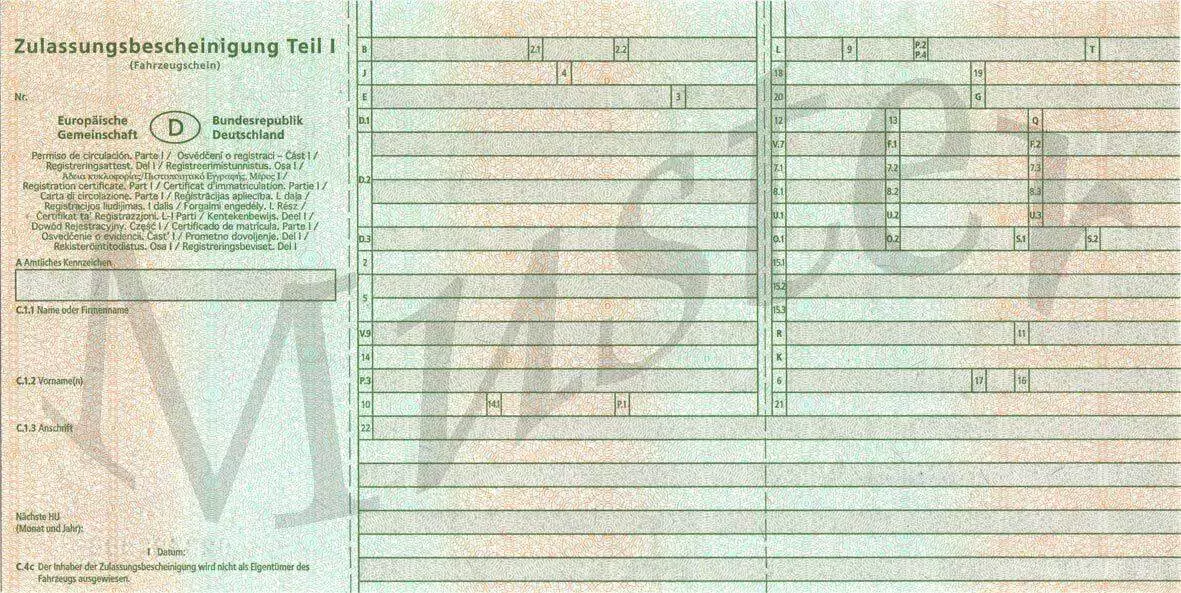
Entries in the vehicle registration certificate
B: Date of first registration of the vehicle
2.1: Manufacturer's key number (HSN)
2.2: Type key number (TSN) with check digit
J: Vehicle class
4: Body type
E: Vehicle identification number (chassis number)
3: Check digit of the vehicle identification number
D.1: Make
D.2: Type / Variant / Version
2: Manufacturer's abbreviation
5: Designation of the vehicle class and body type
V.9: Emission standard for EC type approval
14: Designation of the national emission class
P.3: Fuel type or energy source
10: Code for P.3
14.1: Code for v.9 or 14
P.1: Engine displacement in cm³
22: Remarks and exceptions
L: Number of axles
9: Number of drive axles
P.2/P.4: Rated power in kW / Rated speed at min-1
T: Maximum speed in km/h
18: Length in mm
19: Width in mm without mirrors and attachments
20: Height in mm
G: Mass of vehicle in operation in kg Unladen mass
12: Tank capacity for tank vehicles in m³
13: Vertical load in kg
Q: Power-to-weight ratio in kW / kg (only for motorcycles)
V.7: CO2 in g/km combined value
F.1: Technically permissible maximum mass in kg
F.2: Maximum permissible mass in the Member State of registration in kg
7.1: Axle load axle 1 in kg
7.2: Axle load axle 2 in kg
7.3: Axle load axle 3 in kg
8.1: Axle load axle 1 in kg
8.2: Axle load axle 2 in kg
8.3: Axle load axle 3 in kg
U.1: Stationary noise in dB A
U.2: Engine speed in min-1 for U.1
U.3: Driving noise in dB A
O.1: Technically permissible braked trailer load in kg
O.2: Technically permissible unbraked trailer load in kg
S.1: Seating capacity including driver's seat
S.2: Standing capacity
15.1: Tires – axle 1
15.2: Tires – axle 2
15.3: Tires – axle 3
R: Vehicle color
11: Code for R
K: EC type approval number or ABE
number 6: Date for K
17: Operating permit characteristic
16: Registration certificate part II number
21: Other remarks
