Key Takeaways
- Digital order documentation eliminates 80% of discussions at the counter through traceable work steps.
- Transparent communication will become a decisive competitive factor for car repair shops in 2026.
- Structured approval processes reduce misunderstandings and create legally compliant documentation.
- Real-time status updates allow customers to monitor the repair progress at any time.
- Automated invoice creation from documented work steps saves up to 3 hours daily.
- Digital documents automatically meet all legal archiving requirements (6-10 years)
- Customer satisfaction measurably increases through transparent cost breakdowns and proof of work performed.
Quick Answer
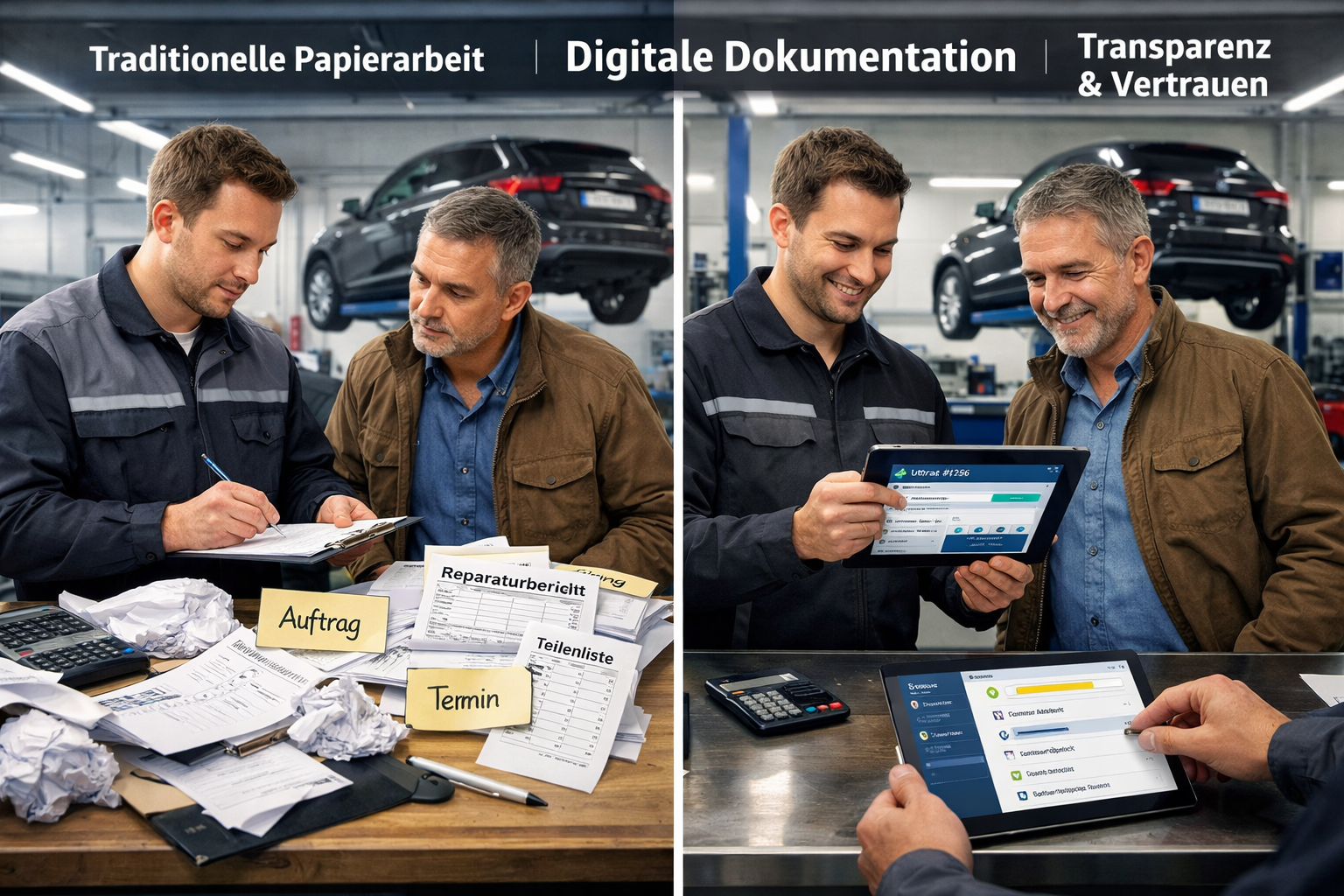
Transparent communication in the automotive repair shop through digital order documentation means: all work steps are digitally recorded, customers receive traceable receipts, and can track the repair progress in real time. This eliminates discussions at the counter and builds lasting trust. Modern workshop software automatically documents approvals, creates transparent invoices, and archives all documents in a legally compliant manner.
Why digital transparency will be vital for workshops in 2026
Process optimization will have become the key success factor by 2026: Transparent, reliable workflows from scheduling to order processing are now essential competitive requirements, no longer optional features.[1] Customers expect seamless digital and transparent processes alongside increasingly complex vehicle technology.[1]
Customer expectations have fundamentally shifted. Instead of simply booking appointments, customers today expect structured, trackable service experiences
- Online appointment booking with instant confirmation
- Digital order communication during the repair
- Cost transparency before work begins
- Real-time status notifications about work progress
- Fast response times (minutes to one hour)[4]
- Binding completion dates with tracking capability
A real-world example: In a survey of approximately 500 Austrian brand dealers conducted from July to September 2026, Mazda achieved first place (7.05 on a scale of 0-10) for supporting dealers during supply chain problems. Key factors identified were proactive production planning and transparent dealer communication .[3]
Hybrid communication is the new standard: customers seamlessly switch between websites, vehicle marketplaces, personal conversations, and AI tools as part of a single dialogue. The industry is no longer "digital or analog," but "both at the same time."[4]
How digital order documentation actually works
Real-time transparency has become operationally critical: Digital process optimization enables service employees to see the vehicle status without recalls, workshop teams to immediately identify customer-approved additional work, and management to receive clear efficiency reports.[1]
Standardized documentation categories
Workshop teams now document digitally:
- Checklists for inspections and maintenance
- Diagnostic results with error codes and measured values
- Customer wishes and special requirements
- Photographic evidence of damage or wear
- Required spare parts with prices and delivery times
This comprehensive, traceable documentation for each order significantly reduces errors and provides a solid basis for business decisions.[1]
Legally compliant archiving
Automotive businesses must comply with various retention periods:
- 6 years of archiving workshop orders
- 10 years of invoice archiving
- Documentation of removed old parts
- Warranty certificates
Modern workshop software solutions automatically integrate these requirements.[5]
Automated release processes
Structured approvals eliminate misunderstandings:
- The cost estimate will be created and sent digitally.
- Customer confirms via email, SMS or app
- The release will be automatically forwarded to the workshop.
- Work will only begin after documented approval.
- Additional work requires separate approvals with price information.
Measurable benefits for workshop operations and customer satisfaction
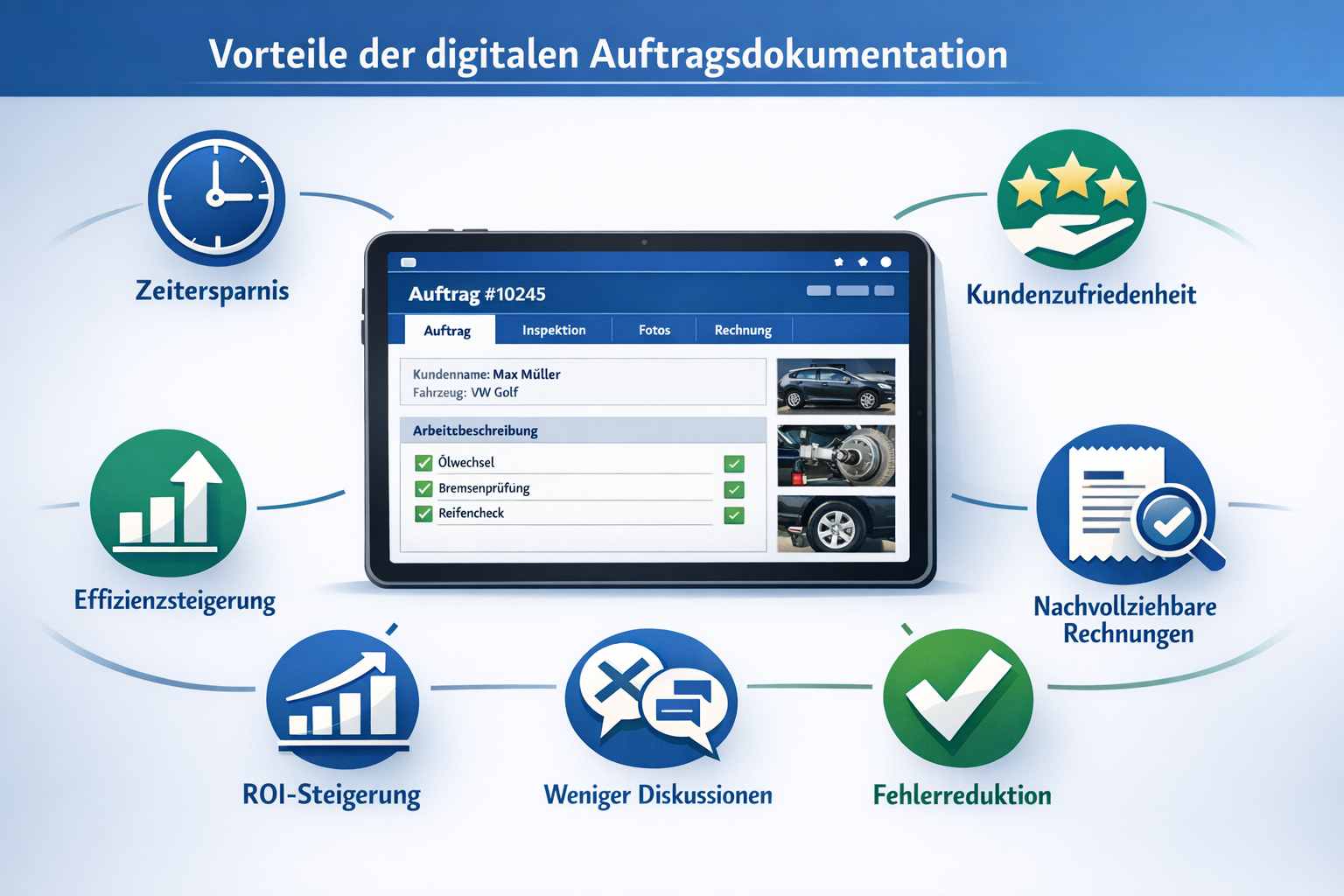
Transparent communication leads to measurable business results: Digital process optimization leads to higher productivity, increased revenue, reduced errors, reduced workload for employees, and improved customer service.[1]
Quantifiable improvements
Time savings in the office:
- Up to 3 hours less administrative work
- 80% fewer discussions at the customer counter
- Automated invoice creation from documented work steps
Quality improvement:
- Drastically reduced error rates through digital processes[5]
- Higher employee satisfaction through clear structures[5]
- Fair distribution of tasks through transparent planning[5]
Customer loyalty:
The customer experience improves in several dimensions:
- Clear appointment coordination without double bookings
- Transparent communication about work progress
- Transparent pricing with cost breakdown
- On-time completion through better planning
- Structured vehicle handover with digital documentation
A professional workflow builds trust – and trust fosters long-term customer loyalty.[1]
ROI calculation for digital transformation
Investment vs. Savings (Example: 5-employee workshop):
| Cost factor | Monthly | Yearly |
|---|---|---|
| Software license | 150€ | 1.800€ |
| Time savings (3h/day at €25) | 1.875€ | 22.500€ |
| Fewer complaints | 500€ | 6.000€ |
| Net savings | 2.225€ | 26.700€ |
Integration with existing systems
Modern automotive invoicing software offers seamless integration:
- DATEV interface for automated accounting
- Spare parts catalogs (Stakis, Stahlgruber) for current prices
- E-invoicing compatibility for B2B customers
- Cloud synchronization for access from anywhere
Practical implementation: Step-by-step to a transparent workshop
Phase 1: Establishing digital foundations (Weeks 1-2)
Immediate measures:
- Workshop software evaluation and testing
- Employee training for digital workflows
- Inform customers about new communication channels
Software selection checklist:
- ✅ User-friendliness for all employees
- ✅ Mobile use on tablets and smartphones
- ✅ Automatic updates without interruptions
- ✅ Data protection compliance (GDPR)
- ✅ Scalability for business growth
Phase 2: Standardize processes (weeks 3-4)
Define workflows:
- Vehicle reception with digital checklist
- Diagnostic documentation with photos and measurements
- Cost estimate with automatic calculation
- Release management with customer communication
- Work progress with status updates
- Billing with verifiable documentation
Phase 3: Optimize customer communication (weeks 5-6)
Setting up communication channels:
- Email templates for standard messages
- SMS notifications for important updates
- Customer portal for order tracking
- Automatic reminders for maintenance appointments
Phase 4: Success measurement and optimization (ongoing)
Monitor KPIs:
- Order processing times
- Customer satisfaction through reviews
- Error rates in invoices
- Employee productivity through time tracking
Avoid common implementation errors
Technical stumbling blocks
Problem: Employee resistance to digitalization.
Solution: Gradual introduction with intensive training and success experiences.
Problem: Data quality during migration.
Solution: Systematic cleanup before migration, parallel systems.
Problem: Customer acceptance of new processes.
Solution: Clear communication of the benefits, retaining optional traditional channels.
Legal pitfalls
Data protection: Process customer data digitally only with explicit consent.
Archiving: Observe statutory retention periods even for digital storage.
E-invoicing: Ensure correct formatting for B2B customers.
FAQ
How long does the switch to digital order documentation take?
Basic implementation takes 4-6 weeks. Workshops typically achieve full process optimization after 3 months with appropriate employee training.
What are the costs for a 5-employee workshop?
Monthly software costs are between €150 and €300. The ROI is usually achieved after 2-3 months through time savings and fewer complaints.
Do all employees have to switch over at the same time?
No, a phased introduction is recommended. Start with vehicle reception and gradually expand to all areas.
How do older customers react to digital communication?
Offer traditional channels in parallel. Many older customers appreciate the transparency of digital documentation when it is explained clearly.
What happens in the event of system failures?
Cloud-based solutions have 99.9% availability. Additionally, offline emergency procedures should be defined.
Are digital documents legally compliant?
Yes, if implemented correctly, digital documents meet all legal requirements. Audit-proof archiving is crucial.
How exactly does customer satisfaction improve?
Customers report 40-60% fewer ambiguities with invoices and 80% higher satisfaction with communication.
Can existing systems still be used?
Modern workshop software offers interfaces to DATEV, Stakis, and other systems. A complete new purchase is usually unnecessary.
How does employee training work?
Most providers offer online training, video tutorials, and personal support. Expect 2-3 training days per employee.
What is the most important success factor?
Consistent use by all employees and clear communication of the benefits to customers. Half-hearted implementation leads to problems.
How do I measure the success of digitalization?
Monitor throughput times, complaint rates, customer reviews, and saved working time. Most systems offer corresponding reports.
What data should be recorded at a minimum?
Vehicle data, working hours, parts used, cost approvals, photos of damage, and all customer communication for traceable documentation.
conclusion
Transparent communication in automotive workshops through digital order documentation will no longer be a nice-to-have by 2026, but essential for business success. Workshops that implement structured, traceable processes now will build lasting customer trust and secure crucial competitive advantages.
Investing in professional workshop software typically pays for itself within a few months through time savings, fewer discussions, and increased customer satisfaction. Start with a thorough analysis of your current processes and test modern solutions without obligation.
Your next steps:
- a free software demo and test the features
- Involve employees in the selection and planning process.
- Start pilot project with one work area
- Measure success and expand gradually
- Proactively informing customers about improved service quality
The future belongs to workshops that build trust through transparency. Start your digital transformation today.
References
[1] Process Optimization 2026 – https://www.digitalesautohaus.de/blog/aktuelles/prozessoptimierung-2026/
[2] Workshop Network Fix Auto Businesses In The Pole Position For Healthy Growth 3529531 – https://www.autohaus.de/nachrichten/schadenbusiness/werkstatt-netzwerk-fix-auto-betriebe-in-der-pole-position-fuer-gesundes-wachstum-3529531
[3] 51442 Transparently Communicated – https://autoundwirtschaft.at/news/51442-transparent-kommuniziert
[4] Customer Communication 2026 What Car Dealerships Need To Know Now – https://www.ldb.de/kundenkommunikation-2026-was-autohaeuser-jetzt-wissen-muessen/
[5] The Workshop Planner For Automotive Workshops Efficient Workshop Planning In 2026 – https://www.catama-software.de/features/der-werkstattplaner-fuer-kfz-werkstaetten-effiziente-werkstattplanung-im-jahr-2026/
