
CATAMA is a cloud-based software solution for motorcycle repair shops that integrates all business processes – from order intake and inventory management to invoicing – into a single system. The solution is specifically tailored to the workflows of motorcycle repair shops and covers typical requirements such as seasonal order peaks, accessory sales, and detailed vehicle histories. CATAMA scales from a single-person workshop to a multi-location company and can be used as a cloud solution without any local installation.
Key Takeaways
- Industry-specific rather than generic: CATAMA maps typical motorcycle workshop processes, including seasonal business, accessory sales and modifications.
- Everything in one system: customer data, vehicle history, workshop orders, parts management, invoices and communication are centrally coordinated.
- Seasonal control: Scheduling and workshop utilization can be managed particularly efficiently during peak periods (spring/summer).
- Real-time transparency: Mechanics, service advisors and the office can see the current order status at any time.
- Complete vehicle history: Maintenance, modifications, repairs and installed parts are fully documented.
- Automatic customer reminders: Inspections, MOT/emissions tests, tire changes and seasonal checks are triggered automatically.
- Professional documents: Offers, orders, delivery notes and invoices are created uniformly and quickly.
- Warehouse and parts management: Spare parts and accessories can be planned, orders are traceable, and downtime is reduced.
- Scalable: From small businesses to branch networks – CATAMA grows with you.
- Cloud-based: No local server required, access from anywhere, automatic updates.
What features does CATAMA offer specifically for motorcycle workshops?
CATAMA delivers functions that are precisely tailored to the working methods of motorcycle workshops – not as an adaptation of car software, but as a well-thought-out overall concept for the two-wheeler industry.
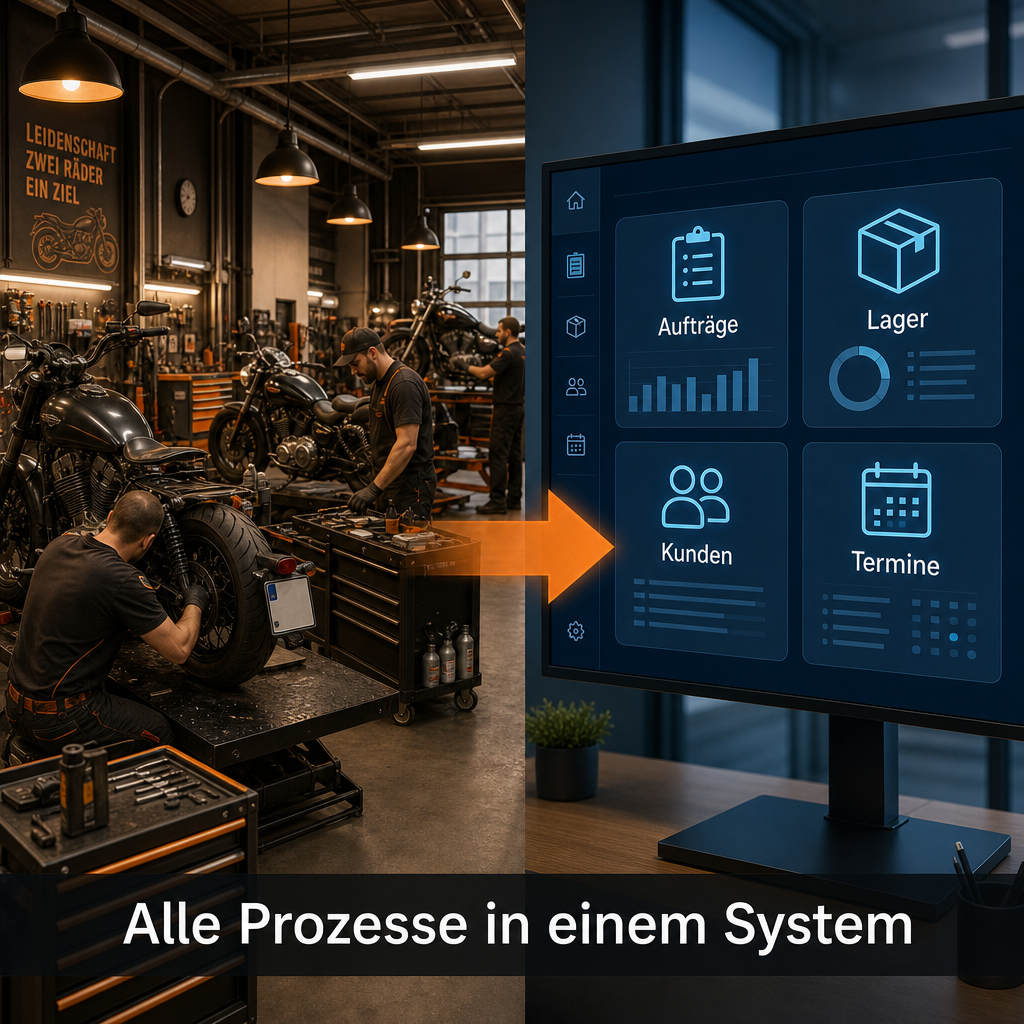
Key functions at a glance
| Functional area | What CATAMA specifically offers |
|---|---|
| Order management | Create, assign, track and bill workshop orders – with real-time status updates |
| Vehicle history | Complete documentation of all maintenance, modifications, repairs and parts installed per motorcycle |
| Scheduling | Workshop planner with capacity control, especially designed for seasonal peaks |
| Customer management | Contact details, vehicle assignment, communication history and automatic reminders |
| Parts & Warehouse | Inventory management, ordering, goods receipt posting and accessories management |
| Invoice | Offers, orders, delivery notes, invoices – standardized and GoBD-compliant |
| Accessories & Add-ons | Integration of accessory sales and workshop services into the overall process |
| interfaces | Integration with parts catalogs, accounting software and suppliers |
Especially relevant for motorcycle repair shops: The software clearly distinguishes between different types of jobs. A tire change, a major modification with add-on parts, and a simple oil change are each handled and billed differently. This saves time and reduces errors.
Anyone wanting a complete overview of the available modules can find details in the CATAMA automotive software complete solution for workshops and trade.
What can CATAMA do better than other workshop software?
The crucial difference: CATAMA is not repurposed office software with an added workshop module. The software was developed from the ground up for automotive businesses and therefore maps industry-specific processes that generic solutions simply don't recognize.
Specific advantages over general software:
- Integrated vehicle database: Motorcycles are recorded with all relevant data – HSN/TSN, chassis number, engine type, year of manufacture and equipment. No manual data entry required.
- Seasonal capacity planning: Motorcycle workshops experience extreme fluctuations between winter and summer. CATAMA offers a workshop planner with appointment schedulingthat manages these peaks.
- Accessories as a business segment: Many motorcycle workshops sell helmets, clothing, and accessories. CATAMA integrates this business directly into the workshop process, instead of managing it separately.
- Cloud advantage: No local server, no IT overhead. Updates are automatic. This is a real cost advantage, especially for smaller businesses.
A common mistake: Workshops choose software based on the lowest price – and then discover that the solution doesn't reflect industry-specific processes. This results in workarounds, manual lists, and duplicate data entry. Learn more in our guide to the advantages of industry-specific software for automotive workshops.
What does CATAMA cost per month for a small motorcycle repair shop?
CATAMA offers various editions that differ in features and number of users. The exact monthly costs depend on the chosen edition. Current prices and editions can be viewed directly on the CATAMA product page, which includes a price overview.
Guidance on the pricing structure:
- CATAMA Professional: For companies with higher demands on evaluations, interfaces and number of users.
- CATAMA Enterprise / Unlimited: For larger companies or branch structures with individual requirements.
Because CATAMA is cloud-based, there are no costs for local servers, maintenance, and manual updates. This significantly reduces overall costs compared to traditional on-premises solutions.
Can I manage spare parts inventory and orders with CATAMA?
Yes. CATAMA includes a complete inventory management module that covers stock levels, orders, goods receipts, and inventory. Motorcycle spare parts and accessories can be managed with minimum stock levels, supplier assignments, and order suggestions.
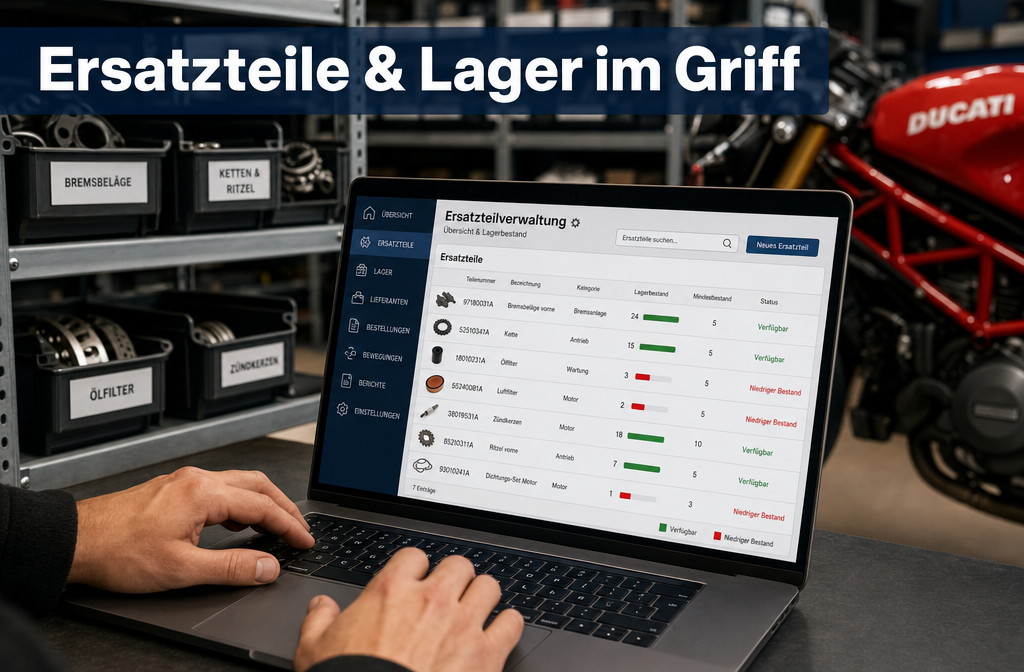
This is how parts management works in practice:
- Create parts: Record items with part number, supplier, purchase price and sales price.
- Inventory management: Automatic inventory adjustment upon goods receipt and order posting.
- Order suggestions: If the minimum stock level is not reached, the system generates order suggestions.
- Book goods receipt: Deliveries are recorded and directly assigned to the warehouse.
- Conduct inventory: Reconcile stock levels with actual counts directly in the system.
Especially important for motorcycle workshops: Accessories and add-on parts (e.g., handlebar grips, mirrors, luggage systems) can be managed just like classic wear parts. This significantly simplifies the combined sale of workshop services and parts.
Details on warehouse management can be found on the page for automotive inventory management and warehouse management.
Is CATAMA also suitable for electric motorcycles?
Yes. CATAMA is not limited to specific drive types. Electric motorcycles can be added and managed just like combustion engine models. The vehicle database does not differentiate by drive type, but records each vehicle individually with its specific characteristics.
Specifically, this means:
- Vehicle data: Manufacturer, model, year of manufacture, chassis number – regardless of the drive system.
- Service history: Maintenance intervals and specific work (e.g. battery checks, software updates) are documented.
- Parts: Even e-motorcycle-specific parts can be kept in stock and assigned to orders.
Edge Case: Those who exclusively service electric motorcycles should check whether manufacturer-specific diagnostic interfaces are required. CATAMA covers the commercial and organizational aspects – manufacturer-specific diagnostic systems remain unaffected.
How easy is CATAMA for employees to use?
CATAMA is a browser-based cloud solution and requires no installation on individual computers. The user interface is designed so that workshop employees without IT knowledge can use it. New employees typically become familiar with it within a few days.
Which makes operation easier:
- Clear structure: Orders, customers, vehicles and warehouses are logically separated and accessible via a central navigation system.
- Role-based views: Mechanics see their orders, the office sees invoices and reports – everyone gets exactly the information that is relevant.
- Templates: Recurring jobs (e.g., inspection, tire change) can be saved as templates and accessed with just a few clicks.
- OCR vehicle recognition: Vehicle data can be automatically captured using a photo of the vehicle registration document, reducing manual input errors.
A common mistake: Companies only train the boss or the office staff, but not the mechanics. This leads to status updates not being updated and a loss of transparency. All users should receive a brief introduction.
Anyone who wants to know how CATAMA digitizes the entire business process will find a detailed description in the guide From acquisition to invoicing: How CATAMA digitizes all business processes.
What mistakes do workshops make when selecting software?
The three most common mistakes when choosing software for motorcycle repair shops are: buying too cheaply, testing too little, and not involving employees.
Typical pitfalls in detail:
- Choose generic software: Accounting software with an attached order module is no substitute for an industry-specific workshop solution. Vehicle histories, parts allocation, and workshop planning are then completely missing.
- Don't use the trial period: Buying software without testing it in daily operations risks costly mistakes. CATAMA offers a free trial version – you should take advantage of it.
- Don't involve employees: If mechanics and service advisors don't accept the software, it will be bypassed. Early involvement is crucial.
- Ignoring interfaces: Anyone who chooses software that does not communicate with the existing accounting system or parts catalogs creates data islands.
- Scalability forgotten: A system that works for three employees must also work with ten employees and a second location.
- Don't underestimate data migration: Moving existing customer and vehicle data requires planning. Without a clear migration plan, data gaps will arise.
Practical tip: Before making a decision, create a list of your ten most important daily processes and check whether the software covers them. It's not the feature list that counts, but rather how well the software covers your own processes.
What are the typical pitfalls when implementing workshop software?
Implementation rarely fails due to the software itself, but rather due to the implementation. The biggest risks are: insufficient time for the transition, inadequate data maintenance, and unrealistic expectations.
Checklist for a successful launch:
- Choose the right time: Don't launch during peak season. Winter or quieter weeks are more suitable.
- Prepare master data: Clean up customer data, vehicle data and article master data before migration.
- Train all employees: Not only office staff, but also workshop employees need an introduction.
- Plan parallel operation: Run the old and new systems in parallel for two to four weeks.
- Designate a contact person: Identify one person within the company as the internal CATAMA contact person.
- Gather feedback: After two weeks, collect targeted feedback and adjust processes.
Those who heed these points will significantly reduce the implementation time. Further tips for increasing efficiency can be found in the guide " How car workshops save time and money with CATAMA software".
Can CATAMA communicate with existing accounting software?
Yes. CATAMA offers interfaces to common accounting systems, in particular a DATEV interface for automated data exchange with tax advisors. Invoice data, journal entries, and receipts can be exported without having to transfer them manually.
Available interfaces (selection):
- DATEV: Automatic export of booking data to the tax advisor.
- E-invoice / XRechnung: GoBD-compliant electronic invoicing.
- Parts catalogs: Connection to systems such as Stakis, Partslink24, WMKat and Repdoc for parts search and price inquiry.
- Suppliers: Electronic order processing with connected wholesalers.
on the page for CATAMA interfaces to suppliers and e-commerce documented
Decision rule: Those who use DATEV benefit immediately from the direct connection. Those using other accounting software should check before deciding whether a CSV or standard export is sufficient, or whether a custom interface is necessary.
Does CATAMA also support multiple locations and branches?
Yes. CATAMA is multi-tenant capable and supports operations across multiple locations. Because the software is cloud-based, all branches access the same database – customer data, vehicle histories, and inventory levels are available across all locations.
This is particularly relevant for motorcycle businesses that operate a branch or separate sales location in addition to their main workshop. Orders can be assigned to specific locations, while analyses and reports provide a comprehensive overview of the entire company.
For larger companies with individual requirements, the CATAMA Enterprise Suite extended functions for multi-stage operations.
Is there a free trial version of CATAMA?
Yes. CATAMA offers a free trial version that allows businesses to test the software in their daily work before committing. Registration is online at Free trial of the CATAMA Cloud workshop software.
During the testing phase, the essential functions are available, allowing you to verify whether the software actually reflects your own processes. This is significantly more informative than any demo presentation.
Recommendation: During the testing phase, run through at least five real orders completely – from acceptance and parts allocation to invoicing. This is the only way to see if the software works in daily operations.
Improved customer loyalty through automated reminders
Motorcycle repair shops rely on repeat customers. CATAMA supports customer loyalty through automatic reminders of upcoming appointments – a mechanism that measurably increases service revenue.
Automated reminders include:
- Due inspections and maintenance intervals
- MOT/Emissions test appointments
- Seasonal checks (spring check, winterization)
- tire change
- Expiry of TÜV or warranty
These reminders are generated directly from the vehicle history. The dealership doesn't need to maintain separate lists or manually track which customer is due when. This reduces administrative effort and ensures repeat business.
Further strategies for customer retention are described in the article " Customer Retention in Car Dealerships: Successful Strategies".
Conclusion
Choosing the right software for motorcycle repair shops determines whether a business operates efficiently or descends into administrative chaos. CATAMA offers a solution specifically tailored to the needs of motorcycle repair shops: seasonal planning, accessories sales, complete vehicle history, and integrated parts management – all in one cloud-based system.
Next Steps:
- Testing: the free trial version and complete at least five real missions.
- Review processes: Identify the ten most important daily processes and check whether CATAMA covers them.
- Involve the team: Include mechanics and office staff in the evaluation process early on.
- Select edition: Choose the appropriate CATAMA edition based on company size and requirements.
- Plan the implementation: Choose a quiet period (ideally autumn/winter) for the transition.
Those who follow these steps lay the foundation for a motorcycle business that operates at a professional level, not only in terms of craftsmanship but also in terms of organization.
FAQ
Is CATAMA only suitable for motorcycle workshops?
No. CATAMA is designed for all automotive businesses, but it particularly well reflects the specific processes of motorcycle workshops – including seasonal business and accessory sales.
Do I need my own server for CATAMA?
No. CATAMA is a cloud solution and runs in the browser. An internet connection and a modern browser are all you need.
Can I import my existing customer data into CATAMA?
Yes. Existing data can be imported. The scope and procedure depend on the previous system.
How often is CATAMA updated?
As cloud software, CATAMA receives regular updates that are installed automatically. Businesses don't need to worry about manual updates.
Does CATAMA support e-invoicing?
Yes. CATAMA supports electronic invoicing in the XRechnung format and is GoBD-compliant.
Can I also manage used motorcycles with CATAMA?
Yes. Vehicles can be listed as merchandise and managed with all relevant data, including differential taxation.
How long does the CATAMA implementation take?
For a small business, the basic setup is possible in a few days. Larger businesses with extensive data migration should plan for two to four weeks.
Are there training courses for CATAMA?
Yes. CATAMA offers support and training opportunities. Contact information is available on the contact and support page .
What happens to my data if I cancel my CATAMA subscription?
The data belongs to the company. A complete data export should be performed before cancellation. Details are governed by the terms of service.
