CATAMA is a cloud-based software solution for automotive workshops and dealerships that combines service processes and vehicle sales in a single system. Instead of working with separate, isolated solutions for the workshop, dealership, and accounting, CATAMA maps the entire operational workflow – from vehicle reception and workshop management to vehicle sales and after-sales service. The result: less administrative work, fewer errors, and higher revenue per employee.
Key Takeaways
- One system for everything: CATAMA replaces several individual solutions with an integrated platform for workshop and trade.
- Cloud-based: No local server required, access from any device with an internet connection.
- Scalable: Suitable for individual workshops from one person up to multi-site operations with several teams.
- Faster processes: Appointments, orders, parts orders and customer communication are centrally managed.
- Stronger customer loyalty: CRM functions with automatic reminders for MOT/emissions tests, inspections and tire changes.
- Clean accounting: Offers, orders and invoices are created uniformly and in compliance with GoBD regulations.
- Interfaces available: Connection to parts catalogs (Partslink24, Repdoc), wholesalers (Stahlgruber/Stakis) and accounting systems.
- Free trial available: CATAMA can be tested without obligation before making a decision.
- Passenger car focus: Primarily developed for the passenger car industry, but also usable for related vehicle sectors.
What can CATAMA software do for a workshop?
CATAMA covers the entire daily workshop routine: from appointment scheduling and direct vehicle reception to order management and parts ordering, all the way to invoicing and customer after-sales service. All processes are integrated within a single system, eliminating the need to enter data twice.
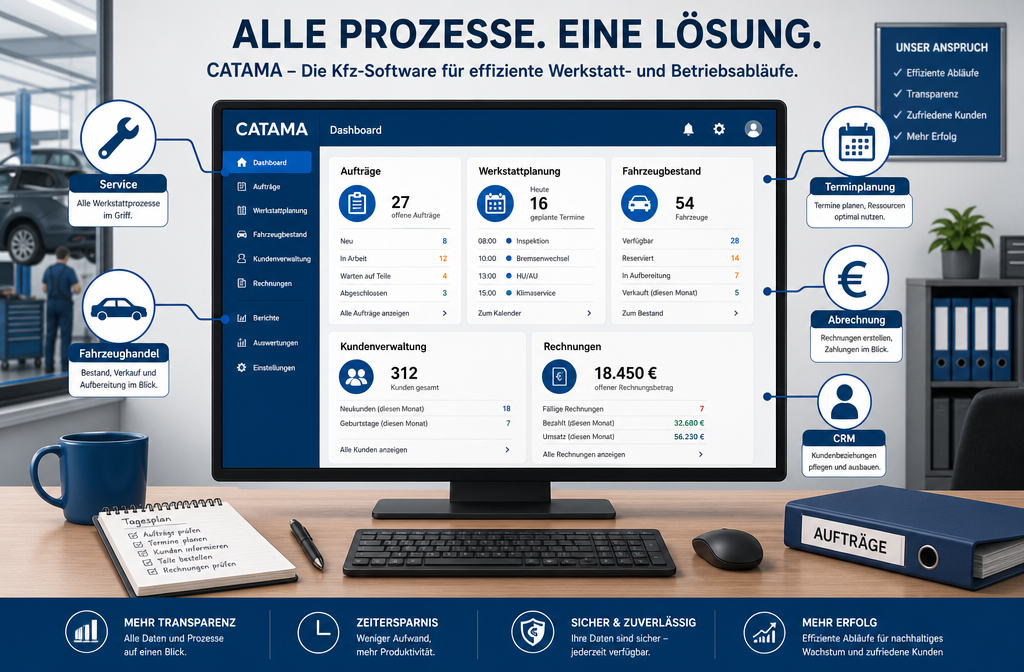
The most important functional areas at a glance
| Area | functions |
|---|---|
| Workshop planning | Appointment calendar, capacity planning, order status in real time |
| Order management | Acceptance, cost estimate, order creation, status tracking |
| Vehicle Management | Vehicle inventory, vehicle history, OCR capture of vehicle data |
| Parts & Warehouse | Inventory management, ordering system, tire storage, goods receipt |
| Customer Relationship Management (CRM) | Contact details, vehicle assignment, communication history, follow-ups |
| Invoice | Offers, invoices, e-invoicing/X-invoicing, cash book, differential taxation |
| Vehicle trade | Vehicle offers, sales process, document management, handover protocol |
A concrete example: A customer calls to schedule an inspection appointment. The employee at the counter immediately sees the vehicle history, the last service, upcoming MOT/emissions test dates, and any outstanding recommendations. The appointment is entered into the workshop planner , the work order is prepared, and the mechanic can see directly the next morning which parts need to be on hand.
A common mistake: Many businesses use separate tools for scheduling, invoicing, and customer management. This leads to data inconsistencies – data is entered multiple times, and information gets lost. CATAMA eliminates this problem because everything is stored in a single database.
What makes CATAMA different from standard workshop software?
The crucial difference: CATAMA is not just workshop software and not just a sales system, but both in one. While most solutions on the market specialize in either service or vehicle sales, CATAMA combines both worlds.
Three key differences
- Workshop + dealership = one system. Businesses that both repair and sell vehicles no longer need two separate programs. Vehicle data, customer history, and sales processes are directly linked. Those interested in the complete solution for workshop and dealership operations will find a detailed overview of its features there.
- Cloud-native, not retrofitted into the cloud. CATAMA was built as a cloud solution from the ground up. This means: no local server, automatic updates, and access from anywhere. Older programs were often migrated to the cloud later, leading to performance issues and limited functionality.
- Modular design with clear scalability. From sole proprietorships to multi-site operations – CATAMA grows with you. Different editions (Professional, Enterprise, Unlimited) are available, tailored to different business sizes and functionalities.
Decision rule: Choose CATAMA if your business combines workshop and trade under one roof, or if you want to switch from several isolated solutions to a single system.
What advantages does CATAMA offer compared to older workshop management programs?
Older workshop management programs are often based on local installations, use rigid interfaces, and lack true integration between the workshop, dealerships, and CRM systems. CATAMA overcomes these limitations with a modern, cloud-based architecture.
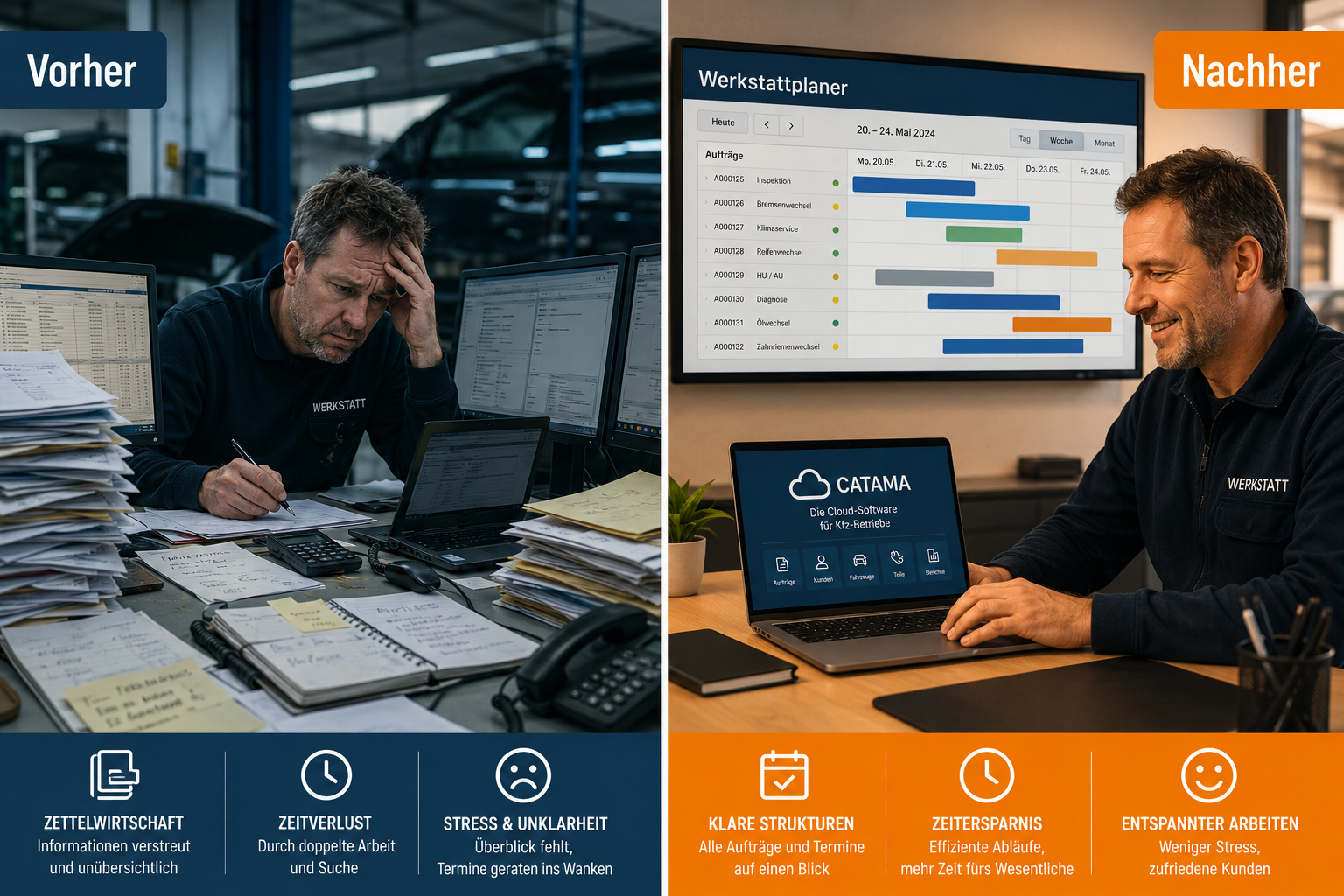
Advantages in direct comparison
| criterion | Older programs | CATAMA |
|---|---|---|
| installation | Locally on a PC/server | Cloud, no server needed |
| Updates | Manual, often subject to a fee | Automatically included in the subscription |
| access | Only on the workplace PC | From any device with a browser |
| Workshop + Retail | Separate modules or programs | An integrated system |
| interfaces | Limited, often outdated | Stakis 4.0, Partslink24, Repdoc and much more. |
| Data backup | Self-responsibility | Automatic cloud backup |
| Scaling | Complex, new licenses required | Flexible customizable via subscription |
One concrete advantage: The Stakis 4.0 integration makes it possible to order parts directly from the order at Stahlgruber – without changing systems, without copy-paste, without sources of error.
Edge Case: Businesses that work exclusively with a single wholesaler and do not engage in any vehicle sales may be able to manage with a simpler solution. However, as soon as multiple suppliers, vehicle sales, or branches come into play, the advantage of integrated software for automotive workshops and dealerships in the passenger car industry becomes clear.
What functions does CATAMA offer for customer management and workshop planning?
CATAMA's CRM manages customer contacts, vehicle assignments, communication history, and automatic reminders. Workshop planning displays capacity, order status, and employee utilization in real time.
Customer Relationship Management (CRM)
- Customer file: All contact details, vehicles, past orders and open offers at a glance.
- Automatic reminders: MOT/emissions test appointments, inspection intervals, tire changes and service campaigns are automatically tracked.
- Follow-up control: Automated follow-up actions can be triggered after a workshop visit or vehicle sale.
- Lead management: Potential buyers are recorded in a structured manner and assigned to the appropriate vehicle.
more information on customer retention options for car dealerships The linked guide provides
Workshop planning
- Visual workshop planner: Orders are distributed to lifting platforms and employees via drag-and-drop.
- Real-time status: Everyone can see whether an order is "in progress", "waiting for parts" or "finished".
- Capacity overview: Free slots and bottlenecks are immediately recognizable.
- Time tracking against orders: Working hours are directly assigned to the respective order, which simplifies post-calculation.
Typical benefit: A workshop foreman with ten open orders can see on the workshop planner at 7:30 a.m. which parts have arrived, which mechanic is working on which order, and which customers are picking up their vehicles today. Without this overview, the day begins with inquiries and searching.
For which size of automotive business is CATAMA best suited?
CATAMA is suitable for automotive businesses of all sizes – from one-person operations to multi-location companies with several teams. The different editions are tailored to different requirements.
Which edition is suitable for which business?
- CATAMA Professional: For medium-sized businesses with a workshop and retail operations that require the full range of functions.
- CATAMA Enterprise: For larger companies with multiple departments or locations.
- CATAMA Unlimited: For businesses that require maximum flexibility and individual support.
How expensive is CATAMA compared to other workshop software solutions?
CATAMA operates on a monthly subscription model. Exact prices depend on the chosen edition and features. Current prices and packages can be viewed on the CATAMA product page .
Cost comparison: What to look out for?
When comparing with other providers such as WerKS+, KSR or Carly, the monthly price is not the only relevant factor:
- Hidden costs: Some providers charge separately for updates, interfaces, or additional workstations.
- Server costs: Local solutions require their own hardware, maintenance and backup – this costs extra.
- Training costs: At CATAMA, support is included in the price, depending on the edition.
- Time savings: An integrated solution saves working time every day that would otherwise be lost to duplicate data entry in separate systems.
A common misconception: Businesses only compare the monthly price and overlook the fact that with a standalone solution, they also pay for accounting software, parts catalog integration, and a CRM system. CATAMA bundles these functions.
What interfaces does CATAMA have with other systems such as accounting?
CATAMA offers interfaces to parts wholesalers, parts catalogs, accounting systems, and other industry-relevant services. This eliminates the need for manual data transfer between different programs.
Important interfaces
- Stakis / Stahlgruber: Direct parts ordering from within the order.
- Partslink24: Access to original parts catalogs from manufacturers.
- Repdoc: Repair costs and spare parts information directly in the system.
- Accounting: Export functions for common accounting programs (e.g., DATEV-compatible formats).
- E-invoicing / XRechnung: Support for legally required electronic invoicing.
- OCR vehicle recognition: Automatic recognition of vehicle data from documents.
A complete overview of all available interfaces can be found on the CATAMA website.
How does the implementation and employee training process work at CATAMA?
Implementing CATAMA typically involves just a few steps: registration, basic configuration, data migration (if desired), and training. Since CATAMA is cloud-based, installation on local computers is unnecessary.
Typical process
- Free trial period: CATAMA can be tested without obligation at first.
- Basic configuration: Operational data, employees, lifting platforms and standard services are set up.
- Data transfer: Existing customer and vehicle data can be imported.
- Training: CATAMA offers online training and support. Depending on the edition, personal support is included.
- Go-Live: Productive work can begin immediately after setup.
Timeframe: For a small business, the basic setup is often completed within a few days. Larger businesses with extensive data migration should plan for one to two weeks.
What are typical mistakes made when implementing CATAMA software?
The most common mistake is transferring old workflows directly to the new system instead of adapting processes to the software's capabilities. CATAMA offers structured workflows – those who ignore these miss out on the majority of the efficiency gains.
The five most common mistakes
- No clear responsibility: At least one person in the company should be designated as the “CATAMA manager” to coordinate the implementation.
- Skipping training: Employees who are not trained only use a fraction of the functions and fall back into old habits.
- Do not clean up data: Before transferring old customer data, duplicates and outdated entries should be removed.
- Too much at once: It is better to start with the core functions (orders, invoices, scheduling) and activate further modules gradually.
- Do not seek feedback: After two to four weeks, the team should discuss what is going well and where improvements are needed.
Can CATAMA also be used for motorcycle or truck workshops?
CATAMA is primarily designed as software for automotive workshops and dealerships in the passenger car industry. However, its core functions – order management, workshop planning, invoicing, and CRM – are also fundamentally usable for motorcycle or truck businesses.
Limitations: Specific functions such as parts catalog interfaces are geared towards automotive parts suppliers. Those who exclusively service trucks or motorcycles should check whether the necessary supplier interfaces are available. For mixed businesses (cars and motorcycles), CATAMA generally works without problems, as order and customer management is independent of vehicle type.
Recommendation: If you are unsure, it is worth testing with the free trial versionto check its suitability for your own business.
Is there a free trial version of CATAMA?
Yes. CATAMA offers a free trial period during which all core functions can be tested. Registration is online, without obligation and without providing payment details.
Free registration is possible directly via the CATAMA website. This allows you to check whether the software is suitable for your business before making a purchase decision.
Improved vehicle sales with the right software for car repair shops and dealerships in the passenger car industry
Many automotive businesses sell used or new vehicles in addition to their repair services. CATAMA maps the entire sales process – from initial contact and vehicle presentation to handover and after-sales service.
What CATAMA offers in the trade
- Vehicle inventory management: All vehicles with photos, documents, costs and status at a glance.
- Sales process: Potential customers are registered, offers are created, test drives are documented, and sales transactions are tracked.
- Differential taxation: Billing methods relevant to the used car trade are integrated.
- Document management: Purchase agreements, handover protocols and other documents are stored centrally.
The software for the automotive trade shows in detail how CATAMA structures vehicle sales.
Practical example: A customer brings their vehicle in for a tire change. During the conversation, they mention that they are considering buying a new car. The employee can directly display suitable vehicles from their inventory in the same system, create a quote, and mark the interested party as a potential buyer in the CRM – without switching systems.
Increased profit through efficiency: How CATAMA boosts productivity and revenue
Less administrative overhead means more time for productive work. CATAMA reduces manual data entry, avoids duplicate entries, and ensures that sales opportunities are not lost.
Concrete efficiency gains
- Fewer media breaks: Data is recorded once and is available everywhere.
- Faster invoicing: With one click, the order becomes an invoice – including all items and labor values.
- Better utilization: The workshop planner shows available capacities, so that gaps can be filled in a targeted manner.
- Structured sales opportunities: No potential customer is lost because follow-ups are automatically initiated.
- Transparency for the team: Every employee knows what's coming up next, which parts are missing, and which order has priority.
Those who wish to delve deeper into the topic will find "How car workshops save time and money with CATAMA software" further practical examples
FAQ
What is CATAMA?
CATAMA is a cloud-based software for automotive workshops and dealerships in the car industry. It combines workshop management, vehicle sales, CRM, invoicing, and inventory management in one system.
Do I need my own server for CATAMA?
No. CATAMA runs entirely in the cloud. A modern browser and an internet connection are all you need.
Can I import my existing customer data into CATAMA?
Yes. CATAMA offers import functions for customer and vehicle data. For larger datasets, CATAMA support is available to assist with the import.
Does CATAMA also work on tablets?
Yes. Since CATAMA is browser-based, it can be used on tablets, laptops and desktop PCs – even directly in the workshop at the lift.
How often is CATAMA updated?
CATAMA receives regular updates with new features and improvements. Because the software is cloud-based, updates are installed automatically without requiring any action from the operator.
Can I use CATAMA for the workshop only, without the sales module?
Yes. The modules are flexible. Those who don't operate a vehicle dealership can simply leave the sales functions deactivated and use only the workshop functions.
Does CATAMA support e-invoicing / XRechnung?
Yes. CATAMA supports legally required electronic invoicing, including the XRechnung format.
Is there telephone support?
Yes, depending on the edition chosen. The higher editions (Enterprise, Unlimited) offer extended support including personal assistance. A contact and support area available for all editions.
How long does the setup take?
For small businesses, the basic setup is possible within a few days. Larger businesses with extensive data migration should allow one to two weeks.
Conclusion: Why CATAMA is the right choice for automotive businesses
The demands on automotive businesses are increasing: customers expect fast communication, transparent pricing, and professional processes. At the same time, the administrative burden is not decreasing due to e-invoicing, data protection, and digital documentation. Specialized software for automotive workshops and dealerships in the passenger car industry, such as CATAMA, is not a luxury, but a business necessity.
Next Steps
- Test it: the free trial version and try out CATAMA in your own company.
- Compare: the different editions and prices and select the appropriate version.
- Planning: Appoint an internal person responsible for the implementation and establish a realistic timeline.
- Schools: Involve all staff members so that the system is used productively from day one.
- Optimize: After four weeks, discuss as a team which functions are working well and where adjustments make sense.
Anyone who wants to map workshop and trade in one system, reduce administrative effort and strengthen customer loyalty will find in CATAMA a well-thought-out solution that grows with the business.
