
Functional overview of the CATAMA software – DATEV Export Accounting Export Module: The complete solution for automotive businesses
Imagine this: It's the end of the month, and while other garage owners are still manually entering invoices into their accounting software late into the night, you can sit back and relax. With a single click, your garage software all documents directly to DATEV – automatically, flawlessly, and in compliance with legal requirements. This time saving is precisely what makes the difference between stressful administrative work and profitable garage management. The functional demonstration of the CATAMA software – DATEV Export Accounting Module – shows how modern digitalization is revolutionizing accounting in the automotive industry and providing businesses with measurable competitive advantages.
Key Takeaways
- ✅ Dual export formats : CATAMA offers both DATEV posting batches (CSV) and document sets (ZIP) for maximum flexibility in accounting integration.
- ⚡ Time savings of up to 85% : Automated data transfer eliminates manual input errors and drastically reduces administrative effort.
- 🔄 Seamless integration : Direct connection to DATEV Unternehmen Online without media breaks or duplicate data entry
- 🎯 Central account configuration : One-time setup of the chart of accounts via product groups ensures consistent postings.
- 🚀 Future-proof : Full compatibility with DATEV's cloud transformation from 2026 and continuous updates included
What is the DATEV export module in CATAMA?
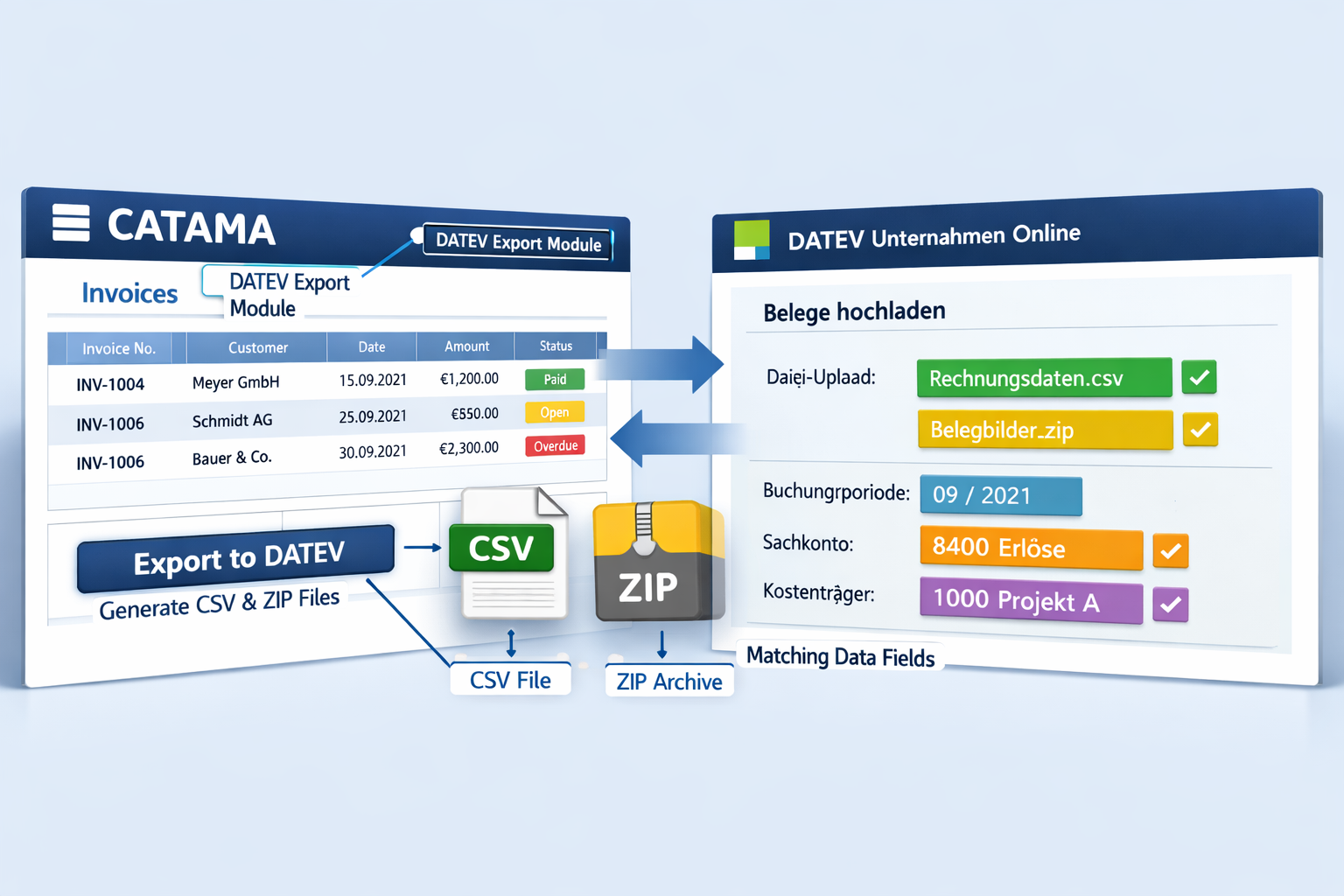
The DATEV export module is the core of accounting automation in CATAMA software. It acts as an intelligent bridge between your automotive workshop management software and the leading accounting system DATEV. While many automotive invoicing programs only offer basic export functions, CATAMA goes significantly further.
How it works at a glance
This module transforms your workshop data – invoices, credit notes, down payments, and other documents – into DATEV-compliant formats. It doesn't simply transfer numbers, but generates complete accounting entries with all tax-relevant information.
Key functions of the DATEV export module:
- 📊 Automatic account assignment based on product groups
- 🔢 Tax breakdown by tax rates and types
- 📅 Accrual accounting for accurate monthly financial statements
- 🔐 Audit-proof documentation of all export processes
- 🎯 Selective export options for maximum control
The CATAMA Professional Suite seamlessly integrates this functionality into the daily workflow, so that accounting no longer takes place as a separate task, but as an automated process.
Why DATEV integration is indispensable for automotive businesses
DATEV is the de facto standard in the German tax consulting landscape. Over 40,000 tax advisors use DATEV systems. For automotive businesses, this means that those who provide their data in a DATEV-compliant format not only save their own time but also tax consulting costs.
"The DATEV interface has reduced our monthly accounting workload from two days to two hours. That's a real increase in efficiency in practice." – Typical feedback from CATAMA users
The vehicle management software with accounting demonstrates how a well-thought-out integration connects all business areas and creates synergies.
The two DATEV export formats: Booking batch vs. document set
The functional description of the CATAMA software – DATEV Export accounting export module – would be incomplete without a detailed look at the two available export formats. CATAMA deliberately offers two different approaches to meet various accounting requirements.
DATEV Booking Stack (ExtFormat) – The classic solution for fast posting
The batch posting export generates a CSV file in DATEV ExtFormat, which can be directly imported into DATEV Unternehmen Online[1]. This format is particularly popular with businesses that primarily want to transfer posting data without full document images.
Advantages of exporting booking batches:
| feature | Advantage | Practical benefits |
|---|---|---|
| File size | Compact (CSV only) | Fast upload speed, low storage requirements |
| Processing speed | Very fast | Ideal for large quantities of documents |
| Account integration | Automatically via product groups | A one-time configuration is sufficient |
| flexibility | Subsequent adjustments possible | Corrections can be made in the DATEV system |
Configuration is done centrally via the product group settings in the "Inventory" section. Here, revenue accounts, cost of goods sold accounts, and other relevant accounts are defined. This one-time setup ensures that all future transactions are automatically and correctly assigned.
Typical use case: A workshop with 150-200 invoices per month uses the batch export function to transfer all receipts in one go at the end of the month. The tax advisor receives the data in a structured format and can begin posting immediately.
DATEV Document Set – The comprehensive document solution
The document export function goes a step further and creates a ZIP archive that contains not only the booking data but also the complete document images (PDF invoices). This corresponds to the modern approach of audit-proof, digital document archiving.
Special features of the document set export:
- 📄 Full supporting images as PDF in the archive
- 🔗 Link between booking entry and document
- ✅ GoBD-compliant archiving directly in DATEV
- 🎯 Selective export function – only new, non-exported documents
The selective export function is particularly valuable: The system remembers which documents have already been exported and offers the option to transfer only new documents. This prevents duplicates and keeps the accounting clean.
Practical example: A car dealership with strict compliance requirements uses the document set export to maintain complete documentation for tax audits. Every invoice is digitally archived and directly linked to the corresponding accounting entry.
Which format is suitable for which business?
The decision between booking stack and document set depends on several factors:
Select booking stack if:
- ✓ Speed and efficiency are paramount
- ✓ Evidence images are archived separately
- ✓ Large volumes of documents are regularly transferred
- ✓ The tax advisor primarily needs booking data
Select document set if:
- ✓ Full digital archiving is desired
- ✓ GoBD compliance has the highest priority
- ✓ Tax audits are frequent
- ✓ Central document management should be implemented in DATEV
The CATAMA Unlimited Edition offers both formats without restrictions and even allows parallel use depending on the document type.
Step-by-step: Setting up and using DATEV export in CATAMA
The practical implementation of the CATAMA software's DATEV Export accounting export module is surprisingly simple. CATAMA relies on intuitive user guidance instead of complicated configuration menus.
Phase 1: Basic configuration of the accounts (one-time)
Before the first export can take place, the accounts in the chart of accounts must be assigned to the product groups. This is done in the "Inventories" → "Product Groups" .
Accounts to be configured:
- Revenue account – For sales revenue of the respective product group
- Cost of Goods Sold Account – For the purchase value of goods sold
- Expense account – For direct costs
- Contra account – By default, the customer account
💡 Pro tip: Use different revenue accounts for different product groups (e.g., repair services, spare parts, tire sales). This allows for detailed analyses later and simplifies cost center accounting.
The efficient automotive workshop ERP software explains in detail how a well-thought-out account structure improves business management.
Phase 2: Perform export
The actual export process follows a standardized workflow that is identical for both formats:
Export process in 5 steps:
- Navigation: Switch to the "Orders" section
- Export button: Click on the export function (usually represented as an icon)
- Document selection: Select document type (invoices, credit notes, etc.) and time period.
- Choose format: Decide between “DATEV booking batch” or “DATEV document set”
- Start export: Confirm the export and download the generated file.
Time required: Approximately 2-3 minutes for 100 receipts – including download.
Phase 3: Import into DATEV Unternehmen Online
The downloaded file (CSV or ZIP) will now be imported into DATEV:
For booking batches (CSV):
- Open DATEV Unternehmen Online
- Navigate to “Bookings” → “Import”
- Select “DATEV format” as the import type
- Upload the CSV file
- Check the preview and confirm the import
For document set (ZIP):
- Open DATEV Unternehmen Online
- Navigate to "Receipts" → "Import"
- Select "Document Set" as the import type
- Upload the ZIP archive
- The system automatically links receipts to bookings
Common stumbling blocks and their solutions
Even mature systems can encounter challenges. Here are the most common problems and their solutions:
Problem 1: Missing account assignment
- Symptom: Error message during import due to unknown accounts
- Solution: Check the product group configuration and add any missing accounts.
- Prevention: Create a checklist of all required accounts before the first export.
Problem 2: Double bookings
- Symptom: Documents appear multiple times in DATEV
- Solution: Use the selective export function (only non-exported documents)
- Prevention: Keep an export log and mark exported periods.
Problem 3: Tax rate discrepancies
- Symptom: DATEV displays different tax rates than CATAMA.
- Solution: Update the tax rate master data in both systems.
- Prevention: Use the automatic updates in CATAMA
The DATEV interface for automotive businesses offers additional guidance on optimal configuration.
Advantages of CATAMA DATEV integration for automotive businesses
The functional demonstration of the CATAMA software – DATEV Export accounting export module – reveals its true strength in the measurable benefits for everyday business operations. It's not just about technical features, but about genuine process optimization with ROI.
Time savings: From days to hours
The most obvious advantage is the drastic reduction in time required. Traditional manual accounting ties up valuable resources:
Time comparison: traditional vs. CATAMA:
| Task | Manually | Using CATAMA DATEV Export | Savings |
|---|---|---|---|
| Recording invoices | 3-4 min./receipt | Automatically | 100% |
| Check account assignment | 1-2 min./receipt | Automatically | 100% |
| Data transmission | 2-3 hours/month | 5 min/month | 97% |
| Error correction | 1-2 hours/month | 10 min/month | 92% |
| Total (150 receipts/month) | ~12 hours. | ~2 hours. | ~83% |
At an average hourly rate of €40 for administrative work, this equates to a monthly saving of €400 – or €4,800 annually. This calculation does not yet take into account the reduced tax consulting costs resulting from accurate data delivery.
Error reduction and compliance
Manual data entry is prone to errors. Studies show that, on average, 1-2% of entries contain errors when entered manually. With 150 receipts per month, this means 2-3 incorrect entries every month.
Typical sources of error that CATAMA eliminates:
- ❌ Transposed digits in amounts
- ❌ Incorrect account assignment
- ❌ Forgotten tax rates
- ❌ Inconsistent period assignment
- ❌ Missing document numbers
Automated data transfer guarantees 100% data integrity between CATAMA and DATEV. What's on the invoice ends up exactly as it appears in the accounting system.
Improved liquidity planning
An often overlooked advantage: Thanks to seamless integration, business owners have up-to-date access to their financial data at all times. No waiting for the monthly report from the tax advisor.
Practical benefits:
- 📊 Daily sales overviews
- 💰 Real-time liquidity monitoring
- 📈 Early trend detection
- 🎯 Informed investment decisions
The time savings achieved through CATAMA demonstrate further efficiency gains in various operational areas.
Scalability without additional effort
A growing business means more receipts. With manual accounting, the workload increases linearly with revenue. With CATAMA, the workload remains constant – whether it's 50 or 500 receipts per month.
Scaling example:
- Start-up phase (50 receipts/month): 5 min. export effort
- Growth phase (200 receipts/month): 5 min. export effort
- Established (500 receipts/month): 6 min. export effort
This scalability makes CATAMA the ideal solution for ambitious businesses that want to grow without being bogged down in administration.
Reduce tax consulting costs
Tax advisors often charge based on time spent. Providing clean, structured data reduces their workload – and therefore the bill.
Typical savings:
- 🔽 20-30% lower accounting fees
- 🔽 Fewer queries and corrections
- 🔽 Faster preparation of annual financial statements
- 🔽 Reduced effort during tax audits
A medium-sized automotive business saves an average of €1,500-3,000 annually in tax consulting costs through optimized data delivery.
CATAMA as a complete solution: More than just DATEV export
The functional presentation of the CATAMA software – DATEV Export accounting export module – is just one piece of the puzzle of the comprehensive CATAMA solution. Its true strength lies in the integration of all business processes.
From order acceptance to accounting – everything from a single source
CATAMA follows the principle of digital order processing without media breaks. Each process step builds on the previous one:
The complete CATAMA workflow:
- Customer acquisition 📞
- Digital customer files with vehicle history
- Scheduling and workshop utilization
- Automatic reminders for maintenance
- Order entry 📝
- Intelligent vehicle recognition via OCR
- Pre-filled from customer master data
- Access to repair manuals (WMKAT, Repdoc)
- Workshop planning 🔧
- Workshop planner with time tracking
- Resource optimization
- Mobile app for mechanics[4]
- Parts order 📦
- Integration with Stakis, Stahlgruber, Partslink24
- Automatic inventory management
- Goods receipt and inventory
- Invoice creation 💶
- Automatic invoice generation
- E-invoice compliance
- Differential taxation for used cars
- Accounting export 📊
- DATEV export (posting batch/document record)
- Automatic account assignment
- Audit-proof archiving
- Controlling & Analysis 📈
- Business intelligence dashboards
- Profitability analyses
- KPI tracking
This seamless integration eliminates duplicate data entry and ensures consistent data across all areas.
Further strengths of the CATAMA platform
Cloud-based architecture:
The cloud solution for workshops offers crucial advantages:
- ☁️ Access from anywhere (office, workshop, on the go)
- 🔄 Automatic backups and updates[7]
- 📱 Mobile Apps for iOS and Android[4]
- 🔐 Professional data centers with the highest security standards[72]
Industry-specific features:
- 🚗 Tire management and storage[32]
- 🔍 HSN/TSN query for vehicle data[45]
- 📋 Digital test reports and checklists
- 🎫 Support desk for customer inquiries[43]
Flexible licensing models:
CATAMA offers different editions for different company sizes:
- CATAMA Smart Edition – For small businesses
- CATAMA Professional – For established workshops
- CATAMA Enterprise – For chain stores and large companies
- CATAMA Unlimited – With premium support
Integration with the entire automotive ecosystem
CATAMA is not a standalone solution, but integrates seamlessly into the existing IT landscape:
Supported interfaces:
- 🔗 Stakis 4.0 Integration[3]
- 🔗 Stahlgruber connection[15]
- 🔗 Partslink24 Connector[29]
- 🔗 WMKAT Repair Guides[32]
- 🔗 Repdoc Technical Information[38]
- 🔗 DATEV Accounting[1][2]
- 🔗 E-commerce platforms[16]
This comprehensive networking makes CATAMA the central platform for digital workshop management .
Future-proof: CATAMA and the DATEV Cloud Transformation 2026
A critical aspect of the functional presentation of the CATAMA software – DATEV Export accounting export module – is its future viability. The software landscape is changing rapidly – especially in 2026.
DATEV's transition to cloud architecture
DATEV has announced that it will migrate all its programs from on-premises installations to cloud-based solutions starting in autumn 2026 [5]. This is a fundamental transformation affecting the entire industry.
What does that mean in concrete terms?
- 🌐 All DATEV applications are provided as cloud services
- 💻 No more local installations required
- 🔄 Automatic updates and maintenance
- 📊 Improved data integration between systems
CATAMA is prepared: As a native cloud solution, CATAMA is already ideally positioned for this transformation. The existing DATEV interfaces are compatible with the new cloud architecture[4].
Development of a Data Service Export
Industry experts expect DATEV to develop a comprehensive data service export for accounting systems[6]. This could further simplify integration:
Possible developments:
- 🔌 REST API for real-time data transfer
- 📡 Bidirectional synchronization
- 🤖 AI-powered accounting suggestions
- 📊 Enhanced analysis capabilities
CATAMA plans to utilize these new capabilities as soon as they become available. The flexible architecture allows for rapid adaptation to new standards.
Continuous updates at no extra cost
A key advantage: All CATAMA editions include automatic updates at no extra cost . While other software providers charge upgrade fees for major updates, CATAMA customers always stay up to date.
What this means:
- ✅ Instant access to new features
- ✅ Automatic security updates
- ✅ Compliance with new legal requirements (e.g. e-invoicing)
- ✅ No investment risks due to version changes
E -invoicing for automotive businesses is a current example: CATAMA has already implemented the legal requirements, while many competitors are still retrofitting.
Compliance and legal certainty
Accounting software must meet the highest legal requirements. CATAMA fulfills all relevant standards:
Certifications and standards:
- ✓ GoBD-compliant – principles of proper accounting
- ✓ GDPR-compliant – General Data Protection Regulation
- ✓ Audit-proof – Unalterable archiving
- ✓ E-invoice ready – XRechnung and ZUGFeRD
The data protection guidelines and data center security document the comprehensive security measures.
Practical examples: How successful companies use CATAMA DATEV export
Theory is good – practice is better. Let's look at how different types of businesses use the functional concept of the CATAMA software – DATEV Export accounting export module – in their daily operations.
Case Study 1: Medium-sized automotive repair shop (3 employees, 120 orders/month)
Initial situation:
Owner Michael K. spent 2-3 days at the beginning of each month on bookkeeping. Invoices were manually entered into Excel and then transferred to DATEV by the tax advisor. Error rate: approx. 5%.
CATAMA solution:
- CATAMA Professional Suite with DATEV booking batch export
- Central account configuration across 8 product groups
- Monthly export on the 1st of the following month
Results after 6 months:
- ⏱️ Accounting effort: from 24 hours/month to 2 hours/month
- ✅ Error rate: from 5% to 0.2%
- 💰 Tax consulting costs: -25% through clean data delivery
- 📈 ROI: Investment pays for itself after 4 months
"I never thought accounting could be so easy. The DATEV export not only saves me time, but also gives me a much better understanding of my business's financial situation." – Michael K., workshop owner
Case study 2: Car dealership with workshop (8 employees, 300 transactions/month)
Initial situation:
Car dealer Sandra M. had separate systems for sales and the workshop. Her accounting was a patchwork of various Excel spreadsheets. Monthly financial statements took up to 5 days to complete.
CATAMA solution:
- CATAMA Enterprise Suite with DATEV document export
- Integration of trade and workshop in one platform
- Differential taxation for used cars[52]
- Weekly export for better cash flow overview
Results after 12 months:
- 🔄 Full process integration achieved
- 📊 Month-end closing: from 5 days to 6 hours
- 💼 Saved on a new part-time employee for accounting (€18,000/year)
- 🎯 Improved liquidity planning through weekly evaluations
Special feature: Thanks to the document set function, Sandra M. has set up a complete digital document archive, which was very positively evaluated during the last tax audit.
Case Study 3: Tire Service Specialist (2 locations, seasonal business)
Initial situation:
Tire dealer Thomas B. experienced extreme seasonal fluctuations (October-November and March-April). During peak periods, invoices often didn't reach his tax advisor until weeks later.
CATAMA solution:
- CATAMA Professional with tire management
- Daily DATEV export during peak season
- Automatic invoice generation immediately after order completion
Results:
- ⚡ Invoicing: 3-5 day delays result in immediate payment
- 💰 Liquidity: 15% improvement through faster invoicing
- 📦 Tire warehouse management integrated with accounting
- 🔄 Both locations combined in one system
Special feature: The combination of fast invoicing and DATEV export allows Thomas B. to have an up-to-date overview of his finances even during peak periods.
Common success factors
All three examples show recurring patterns:
- Time savings of 80-90% on accounting tasks
- Error reduction to below 1% through automation
- ROI within 3-6 months through efficiency gains
- Improved decision-making basis through up-to-date financial data
- Reduction of tax consulting costs by 20-30%
The advantages of industry-specific software become particularly clear in practice.
Frequently asked questions about CATAMA DATEV export
Is technical knowledge required for DATEV export?
No. CATAMA was intentionally designed so that even users without IT knowledge can perform the export. The interface is intuitive, and after the accounts are set up once, the export process is largely automatic. Many users perform the export themselves without needing assistance.
How long does the initial setup take?
The basic configuration (assigning accounts to product groups) takes 1-2 hours for average businesses. CATAMA offers templates for typical charts of accounts, which speeds up the process. support is also available for setup if needed.
Can historical data also be exported?
Yes. CATAMA allows you to export data for any time period, even retrospectively. This is particularly useful when switching systems or when corrections are needed later. The selective export function prevents duplicates.
What are the additional costs for the DATEV interface?
The DATEV export function is included in all CATAMA editions at no extra charge. There are no additional license fees or transaction charges. Interface updates are also free of charge.
Is CATAMA also suitable for Austria and Switzerland?
Yes. CATAMA offers special versions for Austria and Switzerland with country-specific tax rates, chart of accounts, and legal requirements.
How secure is my data during transmission?
Data transmission is encrypted. Export files are stored locally on your computer and imported from there into DATEV. There is no automatic cloud transfer. Data security meets the highest standards.
Can I manage different clients in CATAMA?
Yes, the higher editions (Enterprise, Unlimited) support multi-tenancy. Each tenant can have its own chart of accounts and export settings.
What happens during DATEV updates or changes?
CATAMA automatically updates the interface whenever DATEV makes changes. As a user, you don't need to do anything – the updates are installed in the background. This was also the case when switching to e-invoicing.
Is there a trial period?
Yes, CATAMA offers a free trial where you can thoroughly test all functions, including DATEV export. This allows you to evaluate the functionality in your specific business environment.
How does support work in case of problems?
CATAMA offers various support channels: telephone hotline, email support, a comprehensive knowledge base , and video tutorials. On-site support is also available for higher editions. The FAQ section answers the most frequently asked questions.
Comparison: CATAMA vs. other automotive workshop software with DATEV interface
fully appreciate the strengths of the functional presentation of the CATAMA software – DATEV Export accounting export module
Evaluation criteria for automotive software with accounting integration
Important factors when selecting software:
| criterion | Weighting | Why is it important? |
|---|---|---|
| DATEV compatibility | ⭐⭐⭐⭐⭐ | Core function for accounting |
| user-friendliness | ⭐⭐⭐⭐⭐ | Daily use must be easy |
| Overall integration | ⭐⭐⭐⭐ | Avoiding isolated solutions |
| Cloud availability | ⭐⭐⭐⭐ | Flexibility and future-proofing |
| Price-performance | ⭐⭐⭐⭐ | ROI must be given |
| Support quality | ⭐⭐⭐ | Help with problems is important |
| Update Policy | ⭐⭐⭐ | Long-term investment security |
CATAMA in comparison to competitors
Strengths of CATAMA:
✅ Two DATEV export formats (posting batch + document set) – many competitors only offer one
✅ Native cloud solution – no local installation required
✅ Complete process integration – from acquisition to accounting from a single source
✅ Free updates – no hidden upgrade costs
✅ Flexible scalability – from small businesses to branch networks
✅ Industry-specific features – tire management, vehicle records, etc.
✅ Modern technology – regular feature updates
Areas where competitors can score points:
⚠️ Market presence – Some established providers have been on the market longer
⚠️ On-premises option – Some businesses prefer local installation
⚠️ Special features – Niche functions for very specific requirements
Typical competitor weaknesses that CATAMA avoids
Many automotive software solutions have characteristic problems:
Problem 1: Outdated technology
- Many systems are based on 10-15 year old architecture
- CATAMA: Modern cloud-native development with current standards
Problem 2: Inflexible licensing models
- Rigid packages that don't fit the operation
- CATAMA: Four different editions for different needs
Problem 3: Expensive Updates
- Major updates often cost 20-30% of the license fee
- CATAMA: All updates included at no extra cost
Problem 4: Poor mobile support
- Many solutions are not optimized for smartphones
- CATAMA: Native apps with offline functionality
Problem 5: Complicated operation
- Overloaded interfaces with a steep learning curve
- CATAMA: Intuitive, modern user interface
The automotive workshop software comparisons show that CATAMA scores particularly well in terms of overall integration and user-friendliness.
For whom is CATAMA the right choice?
CATAMA is a perfect fit if:
- ✓ You are looking for a complete solution instead of individual systems
- ✓ Cloud-based work is attractive to you (access from anywhere)
- ✓ Automation and time savings are a priority
- ✓ You grow and need scalability
- ✓ Modern technology and regular updates are important
- ✓ Transparent costs without hidden fees are desired
Alternative solutions might be a better fit if:
- ⚠️ You absolutely need an on-premises installation
- ⚠️ Very specific niche requirements exist
- ⚠️ Massive investments have already been made in another system
