
Imagine this: A customer comes into your workshop for a simple oil change. With the right data, you could immediately see that their vehicle is due for inspections, that wear parts need replacing, and that suitable seasonal tires are available in stock. An €80 job suddenly becomes a €450 service package – without pushy sales tactics, but through intelligent vehicle inventory management and data-driven customer service. This is precisely where the enormous potential lies that many workshop owners are still unaware of.
In a time of tight margins and intensified competition, simply delivering good work is no longer enough. The most successful automotive businesses of 2026 will use structured inventory management systems and data analytics to optimize every single customer order. They will know precisely which parts are profitable, where storage costs are unnecessarily tying up capital, and how to extract more value from each service visit through intelligent processes.
Key Takeaways
- 💰 Increased sales through data analysis : Structured automotive inventory management enables contribution margin analyses that identify high-margin parts and facilitate targeted sales strategies.
- 📊 Up to 30% inventory reduction : Modern inventory management systems reduce unnecessary capital tied up while maintaining service readiness[3]
- ⚡ 60% less administrative effort : Automation of ordering processes, supplier integration and inventory tracking saves valuable working time[3]
- 🎯 Over 98% inventory accuracy : Digital recording upon receipt of goods and guided warehouse processes eliminate costly stockouts[1]
- 🔮 Predictive Analytics : AI-based systems forecast parts requirements, identify supply chain bottlenecks and are becoming increasingly affordable for smaller workshops [3]
Why traditional workshop management leaves money on the table
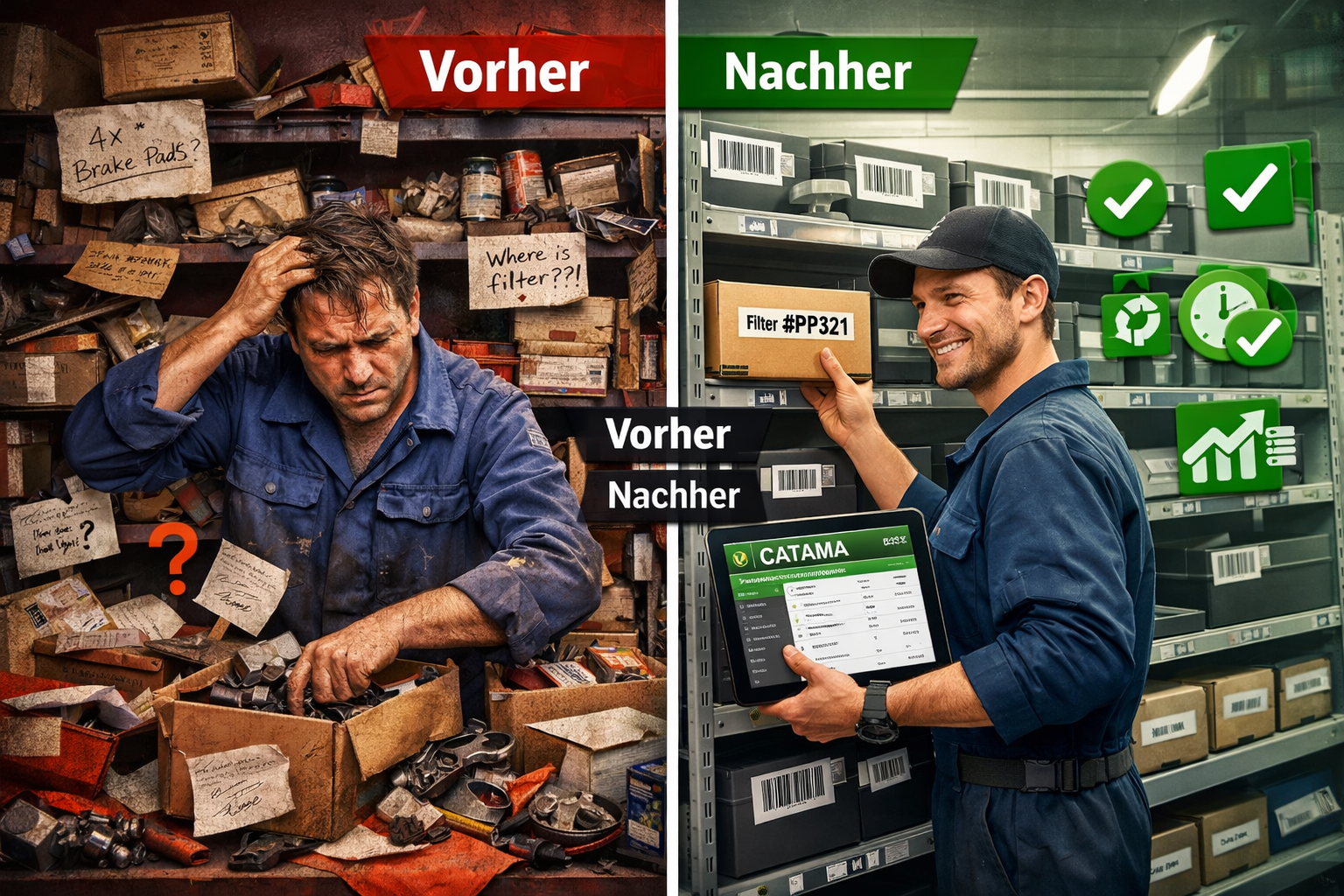
Most garage owners are familiar with the problem: at the end of the month, the figures don't match the feeling. A lot of work has been done, the lifts have been fully utilized, but profits fall short of expectations. The reason often isn't a lack of expertise or too few orders, but rather invisible inefficiencies that systematically erode profits.
The hidden cost drivers in everyday workshop life
Opaque inventory management is one of the biggest profit killers. Without structured automotive inventory management, many businesses don't know exactly which parts are actually in stock. The consequences:
- 🔴 Emergency orders with express surcharges that eat up margins
- 🔴 Duplicate orders of already existing parts
- 🔴 Outdated inventory that will never be sold
- 🔴 Capital tied up in slow-moving items
A study shows that workshops reduce their inventory by up to 30% without jeopardizing service readiness [3]. This translates into direct cash flow gains and improved liquidity.
Missed sales opportunities due to lack of data
Without systematic data collection and analysis, lucrative opportunities remain undiscovered:
- ❌ No overview of customer history and outstanding services
- ❌ No detection of seasonal sales patterns
- ❌ Lack of transparency regarding actual margins per order
- ❌ No identification of highly profitable service packages
Modern workshop software, on the other hand, provides precise analyses of workshop utilization, throughput times, waiting times, productivity per employee, and sales potential [5]. These key performance indicators are the key to strategic decisions that sustainably increase revenue per order.
The administrative time-waster
Many workshop owners spend more time on paperwork than on strategic business management. Manual invoicing , manual inventory management, and unstructured customer files not only waste time but also lead to costly errors.
Automating order processes and using digital data capture can save up to 60% of administrative effort [3]. This time saved can be invested in customer-oriented consulting and sales – precisely where revenue is generated.
Structured automotive inventory management: The foundation for increased sales
A professional automotive inventory management system is far more than just a digital stock list. It's the central nervous system of your business, bringing together and intelligently linking all relevant information. Only through this structure do connections become visible, leading to concrete increases in revenue.
The core functions of modern merchandise management systems
A high-performance automotive invoicing program with inventory management offers far more than basic functions:
Real-time inventory overview 📦
Modern systems provide an immediate overview of stock levels, minimum quantities, and storage costs across all locations[3]. You know at all times what is available, what needs to be reordered, and where capital is unnecessarily tied up.
Automated order suggestions 🤖
Supplier integration generates automatic order suggestions, real-time availability checks, and price comparisons without manual intervention [3]. This saves time and prevents emergency orders with expensive express surcharges.
Guided goods receipt processes ✅
Digital capture upon goods receipt ensures over 98% inventory accuracy [1]. Each item is scanned upon arrival, automatically assigned to the correct storage location, and recorded in the system. Errors are minimized, and inventory is simplified.
Mobile data capture systems 📱
Barcode scanning with tablets enables continuous inventory counts across different warehouse areas on a monthly rotation basis[3]. Instead of shutting down the entire operation once a year, the workload is spread throughout the year.
Integration with the entire workshop process
The true strength of a structured automotive inventory management system lies in its seamless integration with other business areas:
| Area | integration | To use |
|---|---|---|
| Order processing | Automatic parts availability check when creating a quote | Faster quotes, realistic delivery dates |
| Workshop planning | Linking partial availability with scheduling | No delays due to missing parts |
| accounting | Automatic recording of goods receipts and issues | Correct inventory valuation, DATEV-compliant accounting |
| Customer history | Overview of installed parts and service intervals | Targeted service reminders, cross-selling |
This networking reduces process errors by up to 70% through guided application logic across all modules[1].
From warehouse management to strategic resource
A modern automotive workshop ERP software transforms your inventory management from a purely administrative tool into a strategic resource:
Intelligent warehouse optimization 🎯
The system analyzes turnover rates, identifies slow-moving items, and suggests optimal order quantities. Fast-moving items are prioritized, while slow-moving items are stocked less frequently. The result: 30% less tied-up capital with improved availability [3].
Supplier management 🤝
Automatic price comparison across multiple suppliers, tracking of delivery times and reliability, management of framework agreements and special conditions. This is how you secure the best purchasing conditions.
Predictive Ordering 🔮
AI-based systems analyze historical data and forecast future parts demand. They recognize seasonal patterns (e.g., tire changes), anticipate supply chain bottlenecks, and warn of price changes [3]. These technologies are also becoming increasingly affordable for smaller workshops.
IoT and automatic inventory tracking
The next generation of inventory management uses Internet of Things technology:
Smart shelves and scales automatically monitor inventory levels and trigger reorders when minimum quantities are not met [3]. These technologies are becoming increasingly cost-effective for medium-sized businesses and often pay for themselves within 12-18 months.
Data analysis: The turbocharger for your revenue per order
Data collection is only the first step. The real value creation comes from intelligent analysis and interpretation. This is where the wheat is separated from the chaff: While average workshops collect their data, the best actively use it to increase revenue.
Contribution margin analysis: Which orders are truly profitable?
Not every order is equally valuable. A detailed contribution margin analysis shows you at the touch of a button:
✨ Identify high-margin parts and services
. Which spare parts, service packages, and repairs generate the highest margins? These insights enable targeted sales promotion and active marketing of profitable services [3].
📉 Optimize low-margin positions:
Which items would benefit from a price adjustment or supplier change? Where can you improve margins through bundling or alternative procurement?
💡 Hidden Profit Generators:
Often it's not the major repairs, but small parts, consumables, or additional services that contribute disproportionately to profitability. Data analysis reveals these.
Understanding and utilizing customer behavior
Modern workshop management tools analyze customer behavior over years:
Service history and predictive maintenance 🔧
The system knows exactly when each vehicle was last serviced, which parts are installed, and when the next service intervals are due. Automatic reminders bring customers back to the workshop before they go to the competition.
Cross-selling potential 💰
When a customer comes in for a tire change, the system automatically displays: brakes at 70% wear, inspection overdue, air conditioning not serviced for 3 years. An €80 job becomes a €450 service package – without pushy sales tactics, but through fact-based advice.
Customer Lifetime Value Analysis 📊
Which customers are most valuable in the long term? Who are regular customers, who own expensive vehicles, who are price-sensitive? This segmentation enables differentiated customer service and targeted loyalty programs.
Process optimization through KPIs
The right key performance indicators (KPIs) make weaknesses immediately visible. A professional cloud solution for workshops provides precise analyses of:[5]
| KPI | Meaning | Optimization levers |
|---|---|---|
| Workshop utilization | What percentage of available working time is used productively? | Optimize scheduling, reduce downtime |
| Processing time per order | How long does an average order take? | Streamline processes, eliminate waiting times |
| Productivity per employee | What revenue is generated per mechanic? | Further training, specialization, better tools |
| Unproductive time | How much time is lost through searching, waiting, and rework? | Optimize warehouse system, quality assurance |
| Revenue per order | Average invoice amount | Cross-selling, service packages, consulting quality |
These metrics not only show current states, but also trends over weeks and months. This allows you to identify early on if productivity is declining or lead times are increasing.
Seasonal Patterns and Forecasting
Data analysis over several years reveals seasonal patterns:
🍂 Autumn : Tire change, headlight check, winter check
❄️ Winter : Battery service, antifreeze, heating maintenance
🌸 Spring : Air conditioning service, summer tires, inspections
☀️ Summer : Holiday checks, air conditioning, convertible maintenance
With this knowledge you can:
- Build up inventory levels proactively
- Plan marketing campaigns strategically
- Optimal use of personnel resources
- Launch special promotions at the right time
Price optimization through data analysis
What is the optimal hourly rate? What prices does the market accept? A systematic hourly rate calculator takes the following into account:
- Fixed costs (rent, insurance, depreciation)
- Variable costs (materials, energy, consumables)
- Personnel costs including ancillary costs
- Desired profit margin
- Typical market prices for the region
- Degree of specialization and quality level
The data analysis also shows which services can be afforded to have price increases (high demand, little competition) and where you need to be more aggressive with your pricing.
Practical implementation: How to get started with structured inventory management
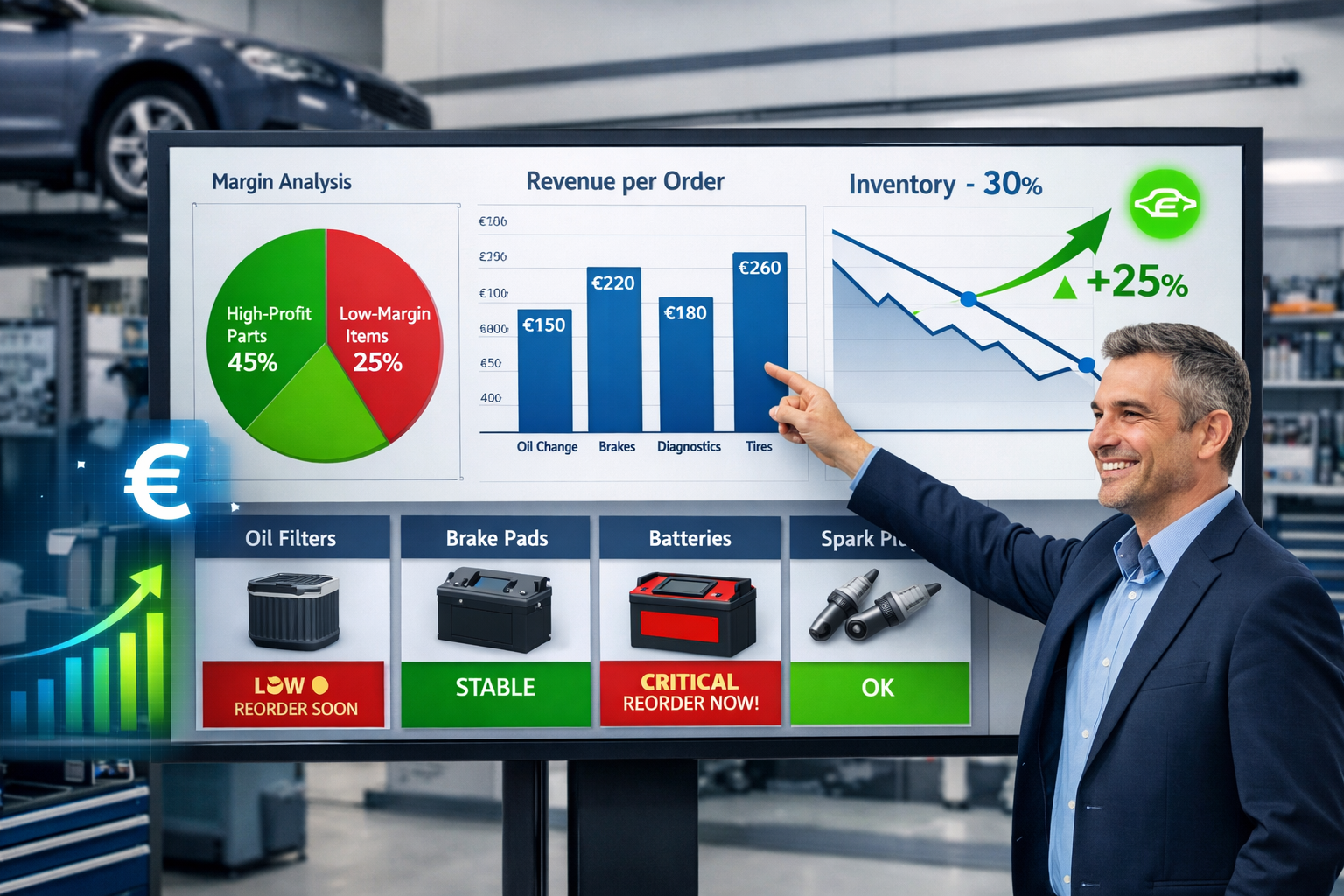
The path to a data-driven workshop doesn't have to be complicated. With the right strategy and step-by-step implementation, you can quickly achieve measurable improvements.
Phase 1: Inventory and goal setting (weeks 1-2)
Analyze current situation 📋
- How much time do you currently spend on administrative tasks?
- How often do emergency orders or stock shortages occur?
- Do you know your actual margins per product group?
- How much capital is tied up in your warehouse?
Define specific goals 🎯
Set measurable goals such as:
- "Reduce inventory by 20% in 6 months"
- "Reduce administrative effort by 50% in 3 months"
- "Increase revenue per order by 15% in 12 months"
- "Increase inventory accuracy to over 95%"
Phase 2: System selection and setup (weeks 3-6)
Choosing the right software 💻
Professional automotive workshop software should meet the following criteria:
✅ Cloud-based for access from anywhere
✅ Industry-specific with automotive features
✅ Integrated (inventory management, invoicing, workshop planning)
✅ Scalable for your growth
✅ GDPR-compliant with German data centers
✅ Interfaces to suppliers (Stakis, Stahlgruber, etc.)
✅ Mobile use for tablets and smartphones
advantage of the trial period 🧪
Use free trial periods to test the software in a real-world environment. Pay particular attention to:
- Intuitive operation (even for non-IT-savvy employees)
- Speed and reliability
- Quality of support
- Training courses and documentation
Phase 3: Data collection and migration (weeks 7-10)
Building master data 📊
- Customer data including vehicle history
- Supplier database with terms and conditions
- Item database with prices and storage locations
- Employee data for time tracking
Conduct an inventory 📦
Use the transition as an opportunity for a thorough inventory. Mobile data collection systems with barcode scanners significantly accelerate this process.
Define processes ⚙️
Specify:
- Who records incoming goods?
- How are withdrawals recorded?
- When are orders triggered?
- How does the inventory process work?
Phase 4: Training and Go-Live (Weeks 11-12)
Involve your team 👥
Success depends on the acceptance of your employees. Invest in:
- Comprehensive training for all users
- Documentation of the most important processes
- Contact person for inquiries
- Positive communication of the advantages (time saving!)
Gradual start 🚀
Begin with one area (e.g., only fast-moving items) and expand gradually. This minimizes risks and allows you to gain experience.
Phase 5: Optimization and evaluation (from week 13)
Regular analyses 📈
Use the evaluation functions weekly:
- Which parts were sold most frequently?
- Where are margins particularly high/low?
- Which customers require service?
- How is the inventory developing?
Continuous improvement 🔄
Adapt processes based on insights:
- Optimize order quantities
- Adjust inventory
- Adjusting prices
- Refining sales strategies
Success stories: Concrete results from practice
Case study 1: Medium-sized workshop (8 employees)
Initial situation:
- Chaotic warehousing with approximately 15% stock discrepancies
- 3-4 emergency orders per week with express surcharges
- No systematic customer approach
- Average order value: 285 euros
After 6 months with structured automotive inventory management:
- ✅ Inventory accuracy over 97%
- ✅ Emergency orders reduced to 0-1 per month
- ✅ Automatic service reminders to 450 customers
- ✅ Average order value: 367 euros (+29%)
- ✅ Inventory reduced by 22% (approx. €18,000 released)
- ✅ Administrative time reduced by 12 hours/week
ROI calculation:
- Software costs: approx. 150 euros/month
- Time savings (12h × 25 Euros): 300 Euros/week = 1,200 Euros/month
- Additional revenue due to higher order value: approx. 3,800 euros/month
- Savings on emergency order costs: approx. 400 euros/month
- Net profit: approx. €5,250/month
Case study 2: Small workshop (3 employees)
Challenge:
The owner spent 60% of his time on office work instead of customer service and strategic business management.
Solution:
Implementation of a cloud-based complete solution with automatic invoice creation, digital order entry and inventory management.
Results after 3 months:
- ⚡ Invoice creation: from 15 minutes to 3 minutes
- ⚡ Office time reduced to 25% of working time
- ⚡ More time spent on customer consultation led to 18% more cross-selling
- ⚡ Increased customer satisfaction (faster quotes, transparent communication)
The 5 most important features of a professional automotive inventory management system
When selecting the right software, you should pay attention to these core functions that make the difference between simple warehouse management and a real revenue driver.
1. Intelligent supplier integration 🔗
Modern systems offer direct interfaces to Stakis, Stahlgruber and other wholesalers. This means:
- Real-time availability : See instantly if parts are available.
- Automatic price comparison : System selects the cheapest supplier
- One-click ordering : Order directly from the order form
- Automatic tracking updates : Know when parts will arrive
This integration not only saves time, but also prevents costly incorrect orders and enables precise customer communication about delivery dates.
2. Mobile accessibility 📱
A modern cloud solution enables access from anywhere:
- Tablet use directly in the workshop
- Smartphone app for owners on the go
- Barcode scanner for fast inventory tracking
- Photo documentation directly at the vehicle
The advantage: No more media breaks. The mechanic records damage directly on the vehicle, scans the required parts, and the system automatically generates the cost estimate.
3. Comprehensive analysis and reporting 📊
Professional systems deliver not just data, but insights:
Sales analyses
- By customer, vehicle, employee, time period
- Development over months and years
- Seasonal patterns and trends
Margin analyses
- Contribution margin per item, order, customer
- High-margin vs. low-margin positions
- Price optimization potential
Efficiency analyses
- Workshop utilization and capacity planning
- Lead times and bottlenecks
- Employee productivity
These analyses form the basis for strategic decisions that will sustainably increase your revenue.
4. Automated customer communication 📧
Modern systems handle customer communication:
- Automatic service reminders based on mileage and time
- Appointment confirmations via email or SMS
- Status updates during the repair
- Digital invoicing with online payment function
The result: Increased customer loyalty, fewer no-shows, and faster payment processing. One workshop reported a 23% increase in repeat customers thanks to systematic service reminders.
5. GDPR-compliant data security 🔒
Professional providers guarantee:
- German data centers with the highest security standards[14]
- Daily backups with disaster recovery
- Encrypted data transmission (SSL/TLS)
- Access control with user rights
- GDPR-compliant data processing
