
Does this sound familiar? A customer is waiting for their vehicle to be repaired, and of all times, the necessary spare part is missing – even though you were certain you had it in stock. Or worse: During inventory, you discover thousands of euros worth of unused parts gathering dust on the shelves. Situations like these are not only nerve-wracking but, more importantly, cost you money . In 2026, professional workshop inventory management is no longer a luxury option but an absolute necessity for any automotive business that wants to remain competitive. The good news: With the right systems and processes, warehouse chaos can be eliminated once and for all – while simultaneously increasing profitability.
Key Takeaways
- ✅ Transparency creates control : A digital inventory management system gives you an overview of stock levels, minimum quantities and storage costs at any time.
- 💰 Save money through optimization : Reduce excess inventory by up to 30% and avoid expensive rush orders.
- 🔄 Automation saves time : Automatic order suggestions and supplier integration reduce administrative effort by up to 60%[4]
- 📊 Data-driven decisions : Analyses of margins, inventory turnover, and profitability show which parts are truly worthwhile.
- 🔗 Seamless integration : Linking parts to orders and invoices eliminates sources of error and accelerates processes.
Why inventory management is so important in the workshop
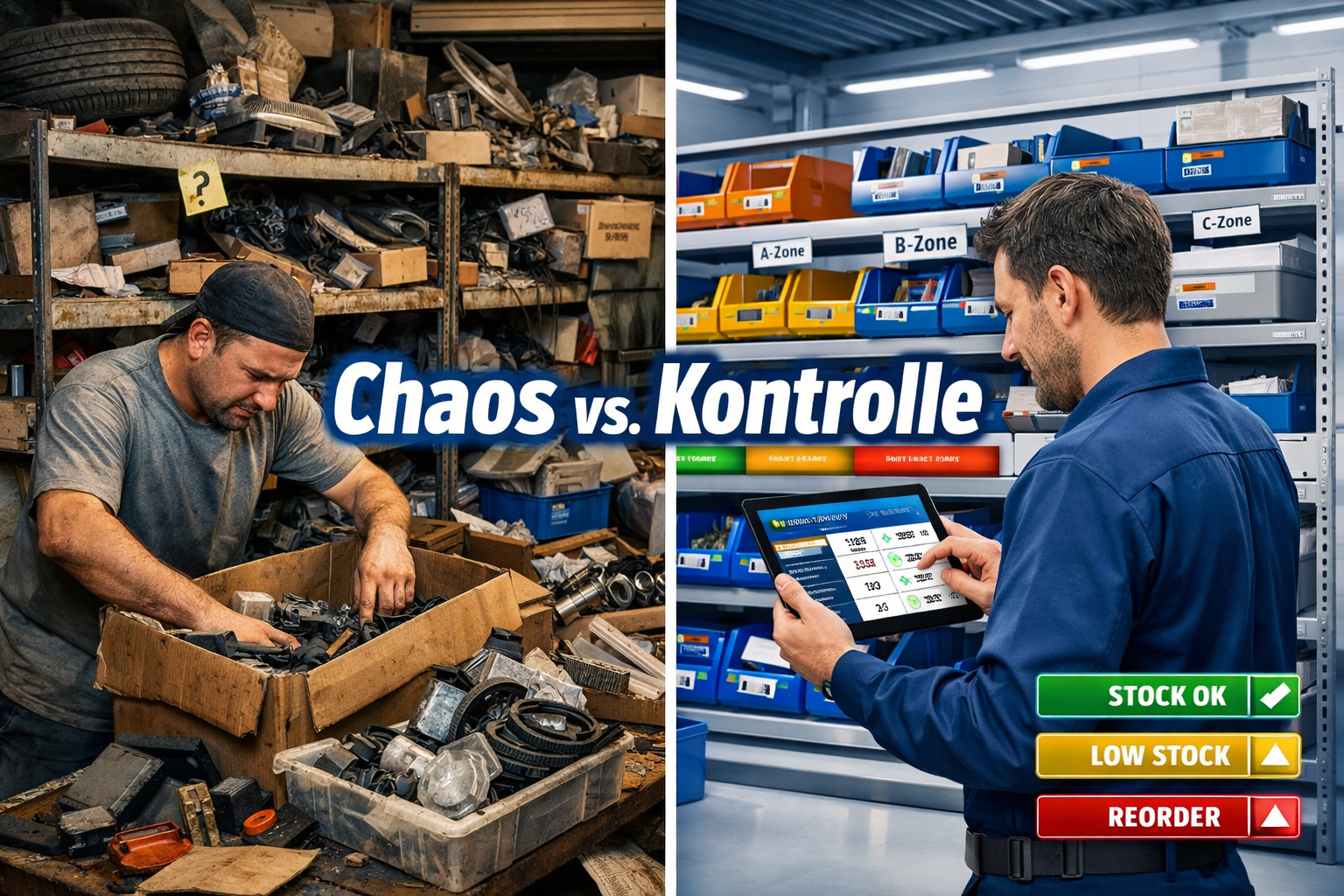
The days of ordering spare parts "by feel" are long gone. In a modern automotive workshop, inventory often accounts for 20-30% of tied-up capital. Without systematic control, several problems can arise:
Unused inventory ties up capital that is needed elsewhere. Parts that are never used gather dust on the shelves and lose value. At the same time, stockouts to delays, dissatisfied customers, and expensive express deliveries. The result: declining customer satisfaction and shrinking margins.
Added to this is the administrative burden : Without digital support, employees spend hours checking inventory, placing orders, and reconciling delivery notes. Time that is then missing from the workshop – and that costs you money.
The hidden costs of warehouse chaos
Many workshop owners underestimate how much money is lost through inefficient warehousing:
- Excess inventory : Too many parts tie up capital and cause storage costs.
- Shrinkage and decay : Oils and lubricants have an expiration date, seals become brittle.
- Search times : Employees spend up to 30 minutes daily searching for parts.
- Incorrect orders : Without a system, parts are ordered twice or the wrong variants are ordered.
- Missed discounts : Unplanned individual orders cost more than strategic group orders.
A professional automotive inventory management system systematically solves all these problems and usually pays for itself in the first year.
The basics of effective inventory management in a workshop
A functioning inventory management system is based on three pillars: transparency , automation , and integration . Let's look at what that means in concrete terms.
Inventory management: The foundation for everything
Without knowing what's actually in stock, you can't make any sound decisions. A modern inventory management system records:
- Item master data : Part number, manufacturer, supplier, purchase price, sales price
- Storage locations : Where exactly is each part located? (shelf, compartment, level)
- Quantities : Current stock, reserved quantities, available quantity
- Movements : When was what moved in or out?
- Batch numbers and expiration dates : Especially important for oils and chemicals
Modern systems support barcode scanners [5], which significantly speed up goods receipt and picking and minimize errors. One scan – and the part is recorded in the system, assigned to the correct order, and removed from inventory.
Intelligently set minimum stock levels and reorder points
This is where the wheat is separated from the chaff: Setting minimum stock levels too high ties up capital unnecessarily. Setting them too low risks supply bottlenecks. The solution lies in data-driven analysis .
| Part type | Recommended minimum stock | Reason |
|---|---|---|
| Fast-moving items (oil filters, brake pads) | 2-3 weeks consumption | Frequent use, predictable demand |
| Seasonal parts (air conditioning components) | Stock up before the season | Avoiding supply bottlenecks during peak times |
| Slow-moving parts (special parts) | Made to order only | Avoid capital commitment |
| Oils and operating fluids | 1 month consumption | Note the expiration date |
Modern inventory management systems analyze your consumption history and automatically suggest optimal minimum stock levels [5]. The system learns continuously: if a part is needed more frequently, the minimum stock level adjusts automatically.
Inventory: From nightmare to routine
The annual inventory is a dreaded event in many workshops. Hours or even days are spent counting every item and comparing it to the system. With digital support, this becomes a fast, precise routine .
Continuous inventory : Instead of counting everything once a year, areas are inventoried on a rotating basis. A different shelf is inventoried each month – this spreads the workload throughout the year.
Mobile data capture : Employees walk through the aisles with a tablet and scanner, scan barcodes, and enter quantities. The system immediately compares the data and displays any discrepancies.
Sample inventory : High-quality A-parts are checked more frequently than inexpensive C-parts – according to the Pareto principle.
The software for recording incoming goods and inventory makes the process not only faster but also more accurate. Discrepancies become immediately visible and can be resolved directly.
Supplier integration: The turbocharger for your inventory management workshop
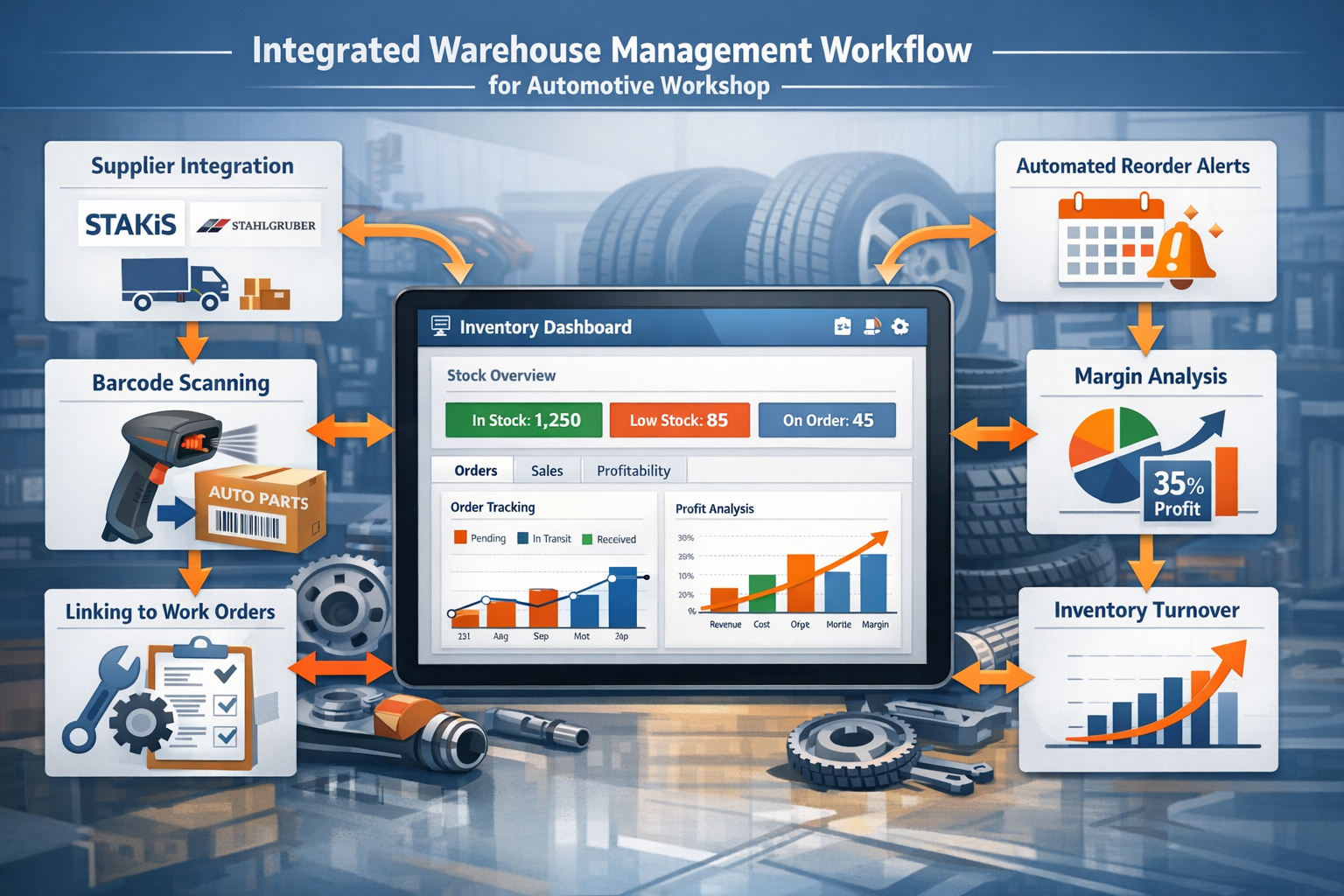
The true strength of a modern inventory management system lies in its seamless integration with suppliers . Instead of manually writing orders, checking availability by phone, or comparing prices, the system handles these tasks automatically.
Automatic order suggestions
When an item falls below the minimum stock level, the system generates a purchase order suggestion [5]. You review the list, adjust quantities if necessary, and place the order with a single click. The order is sent directly to the supplier electronically – no more phone calls, faxes, or emails are needed.
Particularly practical: The system takes the following into account:
- Delivery times : Parts with longer delivery times will be reordered earlier.
- Minimum order quantities : Automatic adjustment to supplier specifications
- Tiered pricing : The system recommends the most economical order quantity.
- Open orders : Parts already reserved are taken into account in the calculation.
Integration with Stakis, Stahlgruber & Co.
Major automotive parts wholesalers offer electronic interfaces that can be directly integrated into your inventory management system. CATAMA software with Stakis & Stahlgruber interfaces enables:
- Real-time availability check : See instantly if a part is available.
- Current prices : No more outdated catalog prices
- Electronic ordering : One click – and the order is with the supplier.
- Automatic delivery note reconciliation : Delivered parts are automatically booked in.
- Invoice reconciliation : The system checks whether the delivery note and invoice match.
This automation not only saves time but also drastically reduces potential errors . No more transposed digits in part numbers, no more forgotten orders, no more price discrepancies between orders and invoices.
Supplier evaluation and optimization
Over time, your system will collect valuable data about your suppliers:
- Delivery reliability : How often do parts arrive on time?
- Completeness : How often are ordered items missing?
- Price trend : Which supplier offers the best price?
- Complaint rate : How often do you have to return parts?
These analyses help you identify the best suppliers and continuously optimize your procurement strategy. You might find that a seemingly inexpensive supplier ultimately ends up being more expensive than a more reliable competitor due to frequent incorrect deliveries.
From order to invoice: Integration is everything
The greatest time savings and error reduction are achieved through the seamless integration of all processes. A typical part of this process goes through the following stages:
1. Needs assessment and ordering
A mechanic creates a cost estimate or work order and adds the required parts. The system:
- Automatically checks stock levels
- Reserved available parts for this order
- Generates order suggestions for missing parts
- Displays alternative parts or suppliers
2. Goods receipt and storage
The ordered parts arrive. The delivery note is scanned:
- Parts are automatically assigned to the order
- The inventory is being updated
- The purchase price is recorded
- The storage location is documented
3. Removal and installation
The mechanic takes the part from the warehouse:
- Scanning the barcode removes the item from the warehouse
- Automatic assignment to the order
- The sales price is taken from the master data record
- The margin is calculated automatically
4. Invoicing
All parts are already recorded when the invoice is generated:
- No more manual input required
- Correct prices guaranteed
- Complete documentation for warranty claims
- Automatic transfer to accounting
This seamless integration eliminates media breaks and thus typical sources of error. Each part is only recorded once – all further steps are automated. This not only saves time but also ensures consistent data across all areas.
The industry-specific software for automotive workshops takes into account all the special features of the industry – from linking with vehicle data to the automatic adoption of manufacturer specifications.
Analyses: Numbers that will change your business 📊
An inventory management system is only as good as the insights you gain from it. Modern systems offer comprehensive analysis and reporting functions [5] that go far beyond simple inventory lists.
Margin analysis: What are you really earning?
Many workshops know their average profit margin – but do you know which individual parts are particularly profitable? A detailed margin analysis reveals:
- High-margin items : Which parts should you actively promote?
- Low-margin items : Where can you adjust prices or find cheaper suppliers?
- Margin development : Are margins decreasing on certain parts? Why?
- Comparison of purchase vs. selling price : Are all price changes from suppliers passed on?
Practical tip : Many workshops find that they make hardly any profit margin on standard parts like oil filters, while special parts are significantly more profitable. This realization allows for targeted price adjustments.
Inventory turnover: How fast is your capital turning over?
Inventory turnover shows how often your inventory is renewed throughout the year. A high turnover rate means that capital is not tied up for long. Low values indicate idle inventory.
Formula : Inventory turnover = Annual cost of goods sold ÷ Average inventory
A healthy inventory turnover rate for automotive repair shops is 4-6 per year. This means that each part sits in the warehouse for an average of 2-3 months before it is sold.
Your inventory management system can calculate the stock turnover for each item individually and shows you:
- Fast-moving items : These are the parts you should always have in stock.
- Slow-moving items : Here you can reduce stock levels
- Slow-moving stock : These are the items you should sell off and no longer store.
ABC analysis: Focus on the essentials
The ABC analysis categorizes your items according to their value:
- A-parts (approx. 20% of items, 80% of value): High-quality parts that deserve special attention.
- B-parts (approx. 30% of items, 15% of value): Medium priority
- C-parts (approx. 50% of items, 5% of value): Inexpensive small parts that tie up little capital.
This categorization helps with prioritization :
- A-parts: Close inventory monitoring, accurate stocktaking, optimal suppliers
- B-parts: Standard processes, regular inspection
- C-parts: Simple ordering processes, more generous minimum stock levels (to reduce ordering effort)
Seasonal analyses
Their system recognizes seasonal patterns :
- Demand for air conditioning components increases in the spring
- More lighting components are needed in autumn
- The demand for batteries and antifreeze increases before winter
These insights enable proactive planning : You can build up stocks in good time before demand increases and suppliers become overloaded.
Special case: Tire management and other storage areas
In addition to spare parts, many workshops have other storage areas with special requirements.
Tire storage: More than just stacking
The tire management and tire storage software must offer specific functions:
- Warehouse management : Which tire set is located where? (Shelf, level, position)
- Customer assignment : Stored customer tires must be clearly assigned.
- Profile depth measurement : Documentation during storage and retrieval
- Seasonal reminders : Automatic notification of customers to change their tires
- Storage fees : Automatic calculation and billing
A well-organized tire warehouse not only saves time searching, but also becomes an additional source of income through storage fees and increases customer loyalty.
Oils and operating fluids
Special considerations apply to oils, coolants and other fluids:
- Batch management : Which batch was delivered when?
- Expiration dates : Timely warning before expiration
- Container sizes : Management of barrels, canisters and small containers
- Environmental regulations : Documentation for authorities
Small parts and consumables
Screws, clips, seals – these small parts don't matter much individually, but they add up:
- Simplified inventory management : Often, a quantity specified in units (pieces, meters, kg) is sufficient.
- Group orders : Small parts are ordered together to reach minimum order values.
- Flat-rate calculations : Instead of charging for each screw individually, many workshops work with flat rates.
Practical implementation: How to get started with digital inventory management
The idea of implementing an enterprise resource planning (ERP) system can seem overwhelming. However, with the right approach, the transition is easier than you might think.
Step 1: Inventory
Before you start, you should know where you stand:
- How many items do you have in stock? (An estimate is sufficient for now.)
- How is your warehouse organized ? (Are there already areas, shelves, compartments?)
- Which suppliers do you primarily use?
- How are the processes currently running ? (Who orders? Who books in? Who takes out?)
Step 2: Build master data
The quality of your inventory management system depends entirely on the master data . You should record the following for each item:
- Article number (own and/or manufacturer's number)
- Designation
- Main supplier
- Purchase price
- Selling price
- Minimum stock
- Storage location
Tip : Don't start with all items at once. Begin with the fast-moving items – the 20% of parts that account for 80% of your sales. These will deliver the fastest return on investment.
Step 3: Define processes
Establish clear rules:
- Who is allowed to remove parts? (All mechanics or only certain people?)
- How are withdrawals documented? (Scanner, manual entry, withdrawal slip?)
- Who is responsible for orders?
- How often is an inventory taken?
Clear processes prevent chaos and ensure that the system remains up-to-date.
Step 4: Train employees
The best software is useless if employees don't use it or use it incorrectly. Invest time in thorough training .
- Why is inventory management important? (Creating motivation)
- How does the system work? (Practical exercises)
- What do I need to be aware of in everyday life? (Standard processes)
- Who do I contact if I have problems? (Support)
Designate a person responsible for inventory management who will serve as the contact person and maintain the system.
Step 5: Continuous optimization
After launch comes optimization. Use analytics to continuously improve:
- Adjust minimum stock levels to actual demand
- Optimize supplier relationships based on data
- Identify slow-moving stock and sell it off
- Provide further training if errors occur repeatedly
The efficient automotive workshop ERP software grows with your requirements and can be expanded step by step.
Typical pitfalls and how to avoid them
When implementing an inventory management system, there are some classic mistakes you should avoid:
❌ Error 1: Incomplete master data
Problem : Items are created, but important fields remain empty (e.g., minimum stock, storage location).
Solution : Define mandatory fields and regularly check data quality. Use import functions to transfer master data from suppliers.
❌ Mistake 2: Lack of discipline when booking
Problem : Parts are removed but not recorded in the inventory. The system displays stock levels that do not reflect reality.
Solution : Make booking as easy as possible (scanners!) and establish clear processes. Regular spot checks will show whether the system reflects reality.
❌ Mistake 3: Structures that are too complex
Problem : Too many storage locations, overly detailed categorizations – the system becomes confusing.
Solution : Start simply and expand gradually. A simple system that is used consistently is better than a perfect system that nobody understands.
❌ Error 4: No integration with other systems
Problem : The inventory management system runs in isolation; data must be manually transferred to other systems.
Solution : Opt for an integrated solution that combines inventory management, order processing, and invoicing.
❌ Mistake 5: Unrealistic expectations
Problem : The system is expected to run perfectly from day one.
Solution : Plan for a 3-6 month implementation phase to optimize processes and clean up data. Perfection comes with time.
The future: Trends in workshop inventory management
Digitalization is progressing, and modern enterprise resource planning (ERP) systems are constantly evolving. Some trends that will already be a reality by 2026[4][5]:
🤖 Artificial Intelligence and Predictive Analytics
AI-powered systems analyze your historical data and make predictions :
- Which parts will be needed in the coming weeks?
- When can supply shortages be expected?
- What price changes can be expected?
These forecasts enable even more precise ordering and reduce both over- and under-stocking.
☁️ Cloud-based systems
Cloud solutions offer crucial advantages[8]:
- Access from anywhere : Check inventory levels even when you're on the go.
- Automatic updates : Always the latest version, without manual installation
- Scalability : Grows with your business
- Data security : Professional data centers with backup strategies
📱 Mobile solutions
Tablets and smartphones are becoming fully-fledged work tools:
- Mechanics order parts directly from the vehicle
- Warehouse workers record incoming goods on their mobile devices
- Inventories are conducted using smartphones
🔗 IoT and automatic inventory tracking
Smart shelves and scales automatically :
- Sensors report when a minimum stock level is breached
- Automatic reordering without manual intervention
- Real-time transparency across all inventory levels
These technologies are still a thing of the future for smaller businesses today, but are becoming increasingly affordable.
Conclusion: Workshop inventory management as a success factor
professional workshop inventory management will no longer be a nice-to-have, but a fundamental requirement for economic success. The advantages are obvious:
✅ Transparency : You always know what's in stock, what's missing, and what's in excess.
✅ Cost reduction : Less dead stock, fewer rush orders, less search time
✅ Time savings : Automation reduces administrative effort by up to 60%[4]
✅ Better decisions : Data-driven analyses reveal where optimization potential lies.
✅ More satisfied customers : Faster repairs thanks to available parts
Investing in a modern enterprise resource planning (ERP) system typically pays for itself within the first year – as our ROI calculator demonstrates. The ongoing savings from optimized processes and reduced warehousing costs far outweigh the software costs.
Next steps: Here's how to proceed
If you are now convinced that your workshop would benefit from a digital inventory management system, we recommend the following steps:
- Analyze your current situation : Use the ROI calculator above to determine your savings potential.
- Define your requirements : What is particularly important to you? Supplier integration? Mobile data capture? Comprehensive reporting?
- Compare solutions : Look at different systems. Pay attention to industry-specific features and integration with other workshop processes.
- Try it for free : Most providers offer trial periods – use these to test the system in everyday use.
- Start small : Begin with the most important parts and expand gradually.
- Train your team : Invest time in thorough onboarding – it pays off.
Digitizing warehouse management is a crucial step towards a modern, efficient workshop. Investing today secures a clear competitive advantage for the future. Warehouse chaos will finally be a thing of the past – allowing you to focus on what truly matters: providing excellent service to your customers.
References
[1] Market FR Automotive Workshop Equipment Stung 115116 – https://www.fortunebusinessinsights.com/de/markt-fr-kfz-werkstattausr-stung-115116
[2] Workshop Optimization 2026: How to Save Up To 30% of Your Time with the Right Equipment – https://www.opti.de/de/c/werkstattoptimierung-2026-wie-sie-mit-der-richtigen-ausstattung-bis-zu-30-zeit-sparen.75688
[3] Process optimization 2026 – https://www.digitalesautohaus.de/blog/aktuelles/prozessoptimierung-2026/
[4] The Workshop Planner for Automotive Workshops: Efficient Workshop Planning in 2026 – https://www.catama-software.de/features/der-werkstattplaner-fuer-kfz-werkstaetten-effiziente-werkstattplanung-im-jahr-2026/
[5] The #1 Enterprise Software for Automotive Workshops and Retailers: Digitalization for Maximum Efficiency – https://www.catama-software.de/ratgeber/die-1-enterprise-software-f
