
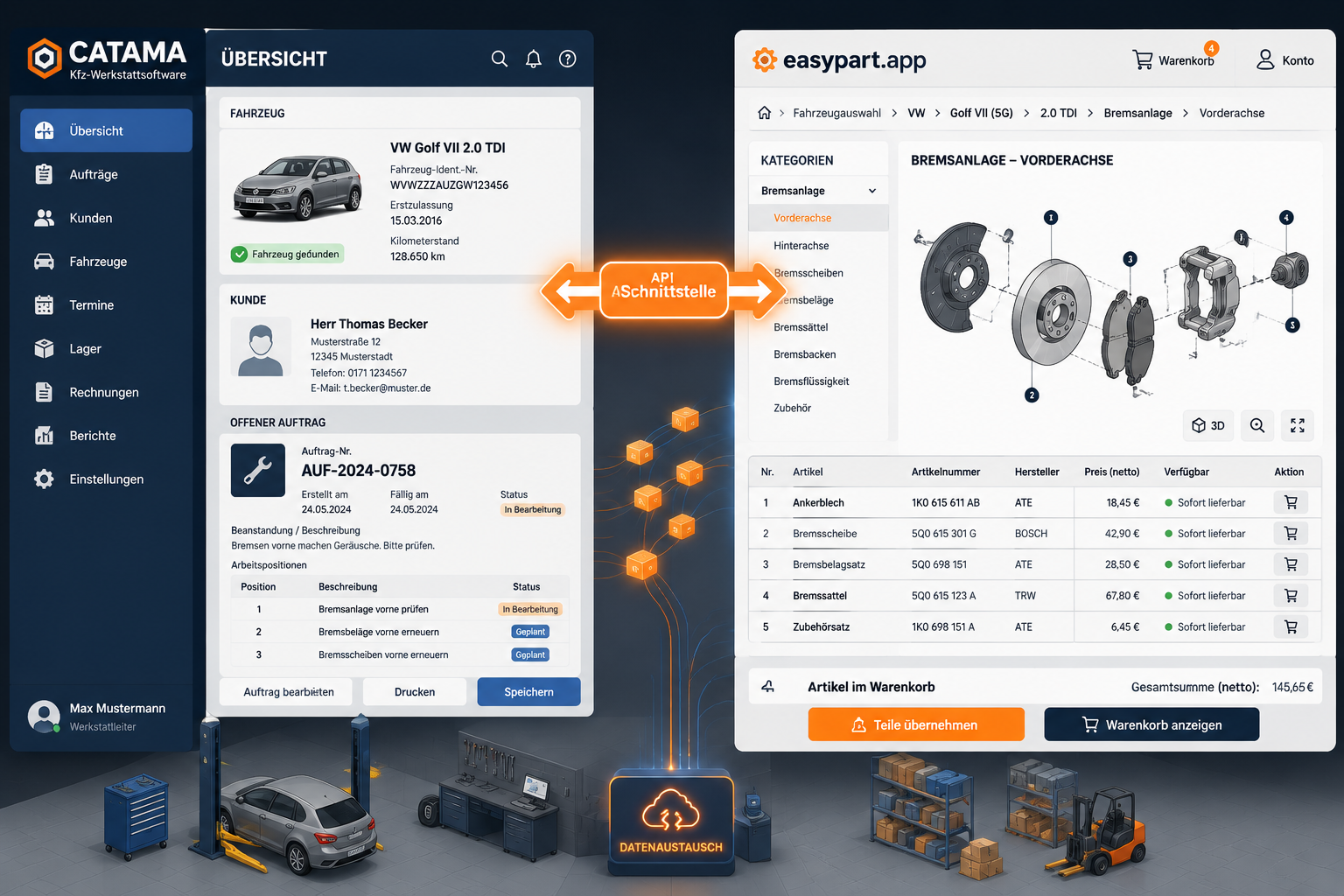
Seven minutes. That is how long the manual search for a single spare part takes in many workshops – including logging into the catalogue, selecting the vehicle, comparing prices and transferring the data into the job. With 30 jobs a day, that adds up to more than three hours of pure clicking. This is exactly where CATAMA with an interface (API) to the easypart parts catalogue comes in: the direct connection to the parts research of app.easypart.app shortens this process to a matter of seconds and transfers part numbers, prices and descriptions directly into the CATAMA job.
For automotive workshops and the car trade, this does not only mean saving time. It means cleaner data, fewer incorrect orders and an uninterrupted process chain from vehicle reception through to the invoice.
Key Takeaways
- The CATAMA with an interface (API) to the easypart parts catalogue integrates easypart’s online parts research directly into the CATAMA automotive software.
- Article data, prices and quantities are transferred into jobs, quotations or invoices without any manual retyping.
- Workshops noticeably reduce search times, ordering errors and duplicate data entry.
- The interface complements existing CATAMA integrations with suppliers such as WMKat, Stakis, Partslink24 and Mercedes-Benz WebParts.
- The connection is part of the modular CATAMA Suite and can be activated to suit the size of the business.
Why an API connection to the parts catalogue is now standard practice
The demands placed on automotive businesses have risen considerably in recent years. Customers expect fast estimates, transparent prices and short vehicle downtimes. At the same time, the sheer variety of parts keeps growing because of new drive systems, assistance systems and model variants. Anyone who still researches parts by telephone, by fax or by switching between several browser windows loses time – and margin.
An API interface solves this problem structurally. Instead of transferring data manually from a catalogue into the workshop software, both systems communicate with each other automatically. The CATAMA with an interface (API) to the easypart parts catalogue is tailored precisely to this use case: it connects the central job and invoicing platform with a modern online parts research tool.
The problems of manual parts entry
In day-to-day practice, the same points of friction come up again and again:
- Typing errors in long part numbers lead to incorrect orders.
- Outdated prices in the calculation sheet erode the margin.
- Duplicate entry in the catalogue and in the workshop software ties up staff.
- A lack of traceability as to which member of staff entered which line item.
- Breaks between media such as browser, PDF, telephone and software.
A direct connection to easypart eliminates these weak points, because the parts data arrives in CATAMA in a structured form and in real time.
What exactly does CATAMA with an interface (API) to the easypart parts catalogue achieve?
The interface is more than a simple data import. It is a two-way connection that dovetails research, selection and transfer. Operation remains within the familiar CATAMA user interface, so there is no additional software to learn.
Range of functions at a glance
| Function | Benefit for the workshop |
|---|---|
| Transfer of the vehicle context | easypart automatically recognises the vehicle from the CATAMA job |
| Article transfer | Part number, description, price and quantity flow into the job |
| Shopping basket import | Transfer several line items at the same time |
| Price updates | Purchase and sales prices based on current catalogue data |
| Images & descriptions | Visual confirmation of the correct part before ordering |
| History | Traceable assignment to job and member of staff |
A typical workflow in practice
- Reception of a vehicle in CATAMA, if required supported by the intelligent vehicle capture using OCR technology.
- Opening the job and calling up the easypart connection directly from the line item entry.
- easypart receives the vehicle context (for example via the HSN/TSN key numbers) and displays matching parts.
- The member of staff selects parts, checks images and prices and adds them to the shopping basket.
- With a single click, all line items are transferred into the CATAMA job in a structured form.
- The job is then calculated, approved and converted into an invoice as usual.
“Anyone who has once worked with a seamless API connection never goes back to searching manually. The time saved is measurable – and so is the error rate.”
Benefits for automotive workshops and the car trade
The benefits can be grouped into four dimensions: time, quality, margin and customer experience. Each of these dimensions has a direct effect on the profitability of the business.
Time: faster quotations and jobs
An average workshop produces between 10 and 40 quotations or jobs a day. If only five minutes are saved per transaction, that adds up to several hours per member of staff per week. This time can be invested either in additional jobs or in the quality of customer advice. The article How automotive workshops save time and money with CATAMA Software provides more background on this.
Quality: fewer errors, cleaner data
Because part numbers, descriptions and prices are taken directly from easypart, the risk of typing errors disappears. The data is stored in CATAMA in a structured form and is available for reports, warranty claims and later repairs.
Margin: current prices and accurate calculation
Outdated price lists are a silent margin killer. The API ensures that the purchase prices stored in CATAMA match the conditions currently available. In combination with the hourly rate calculator for automotive workshops, the overall calculation can be controlled precisely.
Customer experience: transparent and fast communication
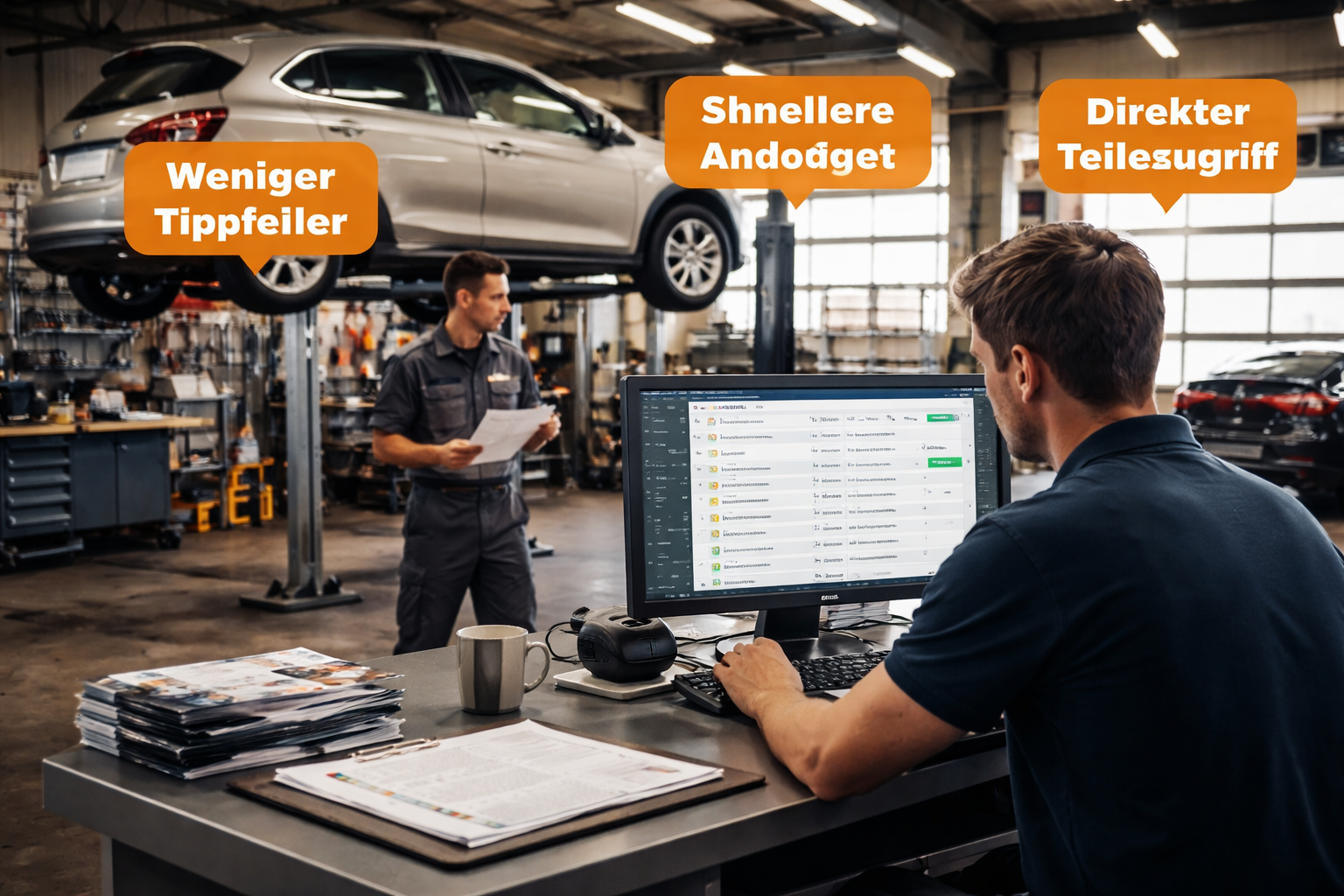
When a customer calls and asks for the price of a repair, the service adviser can draw up a reliable preliminary estimate right there on the telephone. The interface turns a 20-minute research task into a 2-minute answer.
Overview of the most important benefits
- Reduced processing time per job
- A lower error rate when ordering
- Better data quality for later analysis
- Higher customer satisfaction thanks to fast answers
- Relief for service and administrative staff
- Consistent processes across all members of staff
Integration into the CATAMA Suite and complementary interfaces
The CATAMA with an interface (API) to the easypart parts catalogue is part of a comprehensive interface ecosystem. CATAMA sees itself as the central hub for all the data in an automotive business – from acquisition through the workshop to accounting. An overview can be found on the page Interfaces of the CATAMA Software to suppliers & e-commerce.
Complementary interfaces at a glance
| Interface | Area of use |
|---|---|
| WMKat | Repair costs, labour value units and spare parts |
| Repdoc | Repair times and labour values |
| Stakis & Stahlgruber | Parts ordering through the wholesale trade |
| Partslink24 | Manufacturers’ original parts catalogues |
| Mercedes-Benz WebParts | Shopping basket import for Mercedes parts |
| easypart | Universal parts research via app.easypart.app |
Thanks to this interplay, every business can choose the combination that suits its brand mix and its supplier structure. An independent workshop might use easypart and Stakis in parallel, while a franchised business adds Partslink24 or Mercedes-Benz WebParts.
Choosing the right CATAMA edition
Depending on the size and the requirements of the business, different editions are available:
- CATAMA Professional – for medium-sized workshops
- CATAMA Unlimited – tailor-made with extended support
- CATAMA Enterprise – for larger businesses and multi-branch structures
A complete product overview including 2026 prices can be found on the page CATAMA automotive software – professional solutions & prices 2026.
Technical foundations of the API connection
Even though the application is deliberately kept simple, it is worth taking a look behind the scenes. Understanding the technical architecture helps to put the reliability and the security of the interface into perspective.
What is an API?
API stands for Application Programming Interface – a standardised interface through which two software systems communicate with each other. In the case of the CATAMA with an interface (API) to the easypart parts catalogue, this means that CATAMA sends a request to easypart (for example „Which brake pads fit vehicle X?“), and easypart replies with structured data that CATAMA can process directly.
Security and data protection
Communication is encrypted using the HTTPS protocol. Authentication and authorisation ensure that only authorised businesses can access their own data. CATAMA sets out the details of how personal data is handled in its privacy policy.
Cloud architecture as the basis
Because both CATAMA and easypart work in the cloud, updates, new data sets and security patches are available immediately. The guide Automotive workshop software: the efficient cloud solution for workshops provides more detail on the cloud strategy behind the software. A local installation or a separate server for parts research is not necessary.
Availability and stability
Businesses can check the availability of all systems at any time via the CATAMA System Status. In the event of a fault, the support ticket system provides fast help.
Practical examples: how the interface works day to day
Theory is one thing, everyday practice quite another. Three typical scenarios show how the connection to easypart changes the working day.
Example 1: brake service on a compact car
A customer reports a squealing noise when braking. The service adviser creates the job in CATAMA, starts the easypart research from within the job and selects pads and discs for the front axle. With a single click, four line items including images and purchase prices are transferred into the job. The estimate is ready in under two minutes.
Example 2: a service with extensive parts requirements
A major service involves filters, oils, spark plugs and small parts. Using the easypart search, all line items are collected in a single shopping basket and handed over to CATAMA together. The workshop saves around 15 minutes of data entry per service – with 20 services a week, that amounts to five working hours gained.
Example 3: an estimate over the telephone
A customer rings to ask about the cost of replacing an exhaust. The member of staff opens the contact management, creates a quotation, calls up easypart and gives a reliable price within a few minutes. The enquiry is therefore converted directly into a job instead of fizzling out in a telephone queue.
What workshops should bear in mind when introducing the interface
An interface only delivers its full benefit once processes and members of staff are taken into account as well. The following points have proven their worth during roll-out:
A step-by-step roll-out
Businesses introducing CATAMA for the first time should first stabilise the core processes – job reception, invoicing and billing. Interfaces such as easypart, WMKat or Stakis are then activated. The guide How CATAMA digitalises all business processes in the automotive trade provides an overview of all the processes involved.
Staff training
Even though operation is intuitive, members of staff benefit from a short briefing. Important topics:
- Calling up the easypart search from CATAMA
- Working with the vehicle context and the search results
- Transferring individual parts versus the shopping basket
- Checking prices and quantities before transferring them into the job
- Dealing with parts that cannot be found
Maintaining master data
The interface works best when the vehicle data in CATAMA is recorded correctly. HSN/TSN, the date of first registration and the engine code should all be kept up to date. The HSN/TSN lookup in CATAMA provides support here.
Analysis and optimisation
After a few weeks it is worth taking a look at the reports: how often is the interface used? Which members of staff create the most jobs with easypart? Where is data still being entered manually? These insights help to sharpen processes further.
The business case: does the connection pay off?
An investment in an interface has to pay for itself. A simple example calculation illustrates the potential:
| Item | Assumption |
|---|---|
| Jobs per day | 20 |
| Time saved per job | 5 minutes |
| Time saved per day | 100 minutes |
| Working days per year | 220 |
| Hours saved per year | approx. 366 |
| Hourly rate (internal) | 60 € |
| Economic value per year | approx. 21,960 € |
Even if the actual time saving turns out to be only half as high, a clear economic benefit remains. On top of that come effects that are hard to measure but nonetheless real, such as fewer complaints, lower rates of incorrect orders and greater staff satisfaction.
Anyone who would like to look more deeply into the economic assessment will find further pointers in the article Efficient automotive workshop ERP software.
Frequently asked questions
Does every workshop need its own easypart access?
Yes, every business uses its own account at app.easypart.app. This guarantees individual terms, suppliers and settings.
Does the interface work for all vehicle makes?
The interface uses easypart’s data pool, which covers a broad spectrum of common car makes. For make-specific original parts, complementary connections such as Partslink24 or Mercedes-Benz WebParts can be combined with it.
Can the interface also be used in the vehicle trade?
Yes. The vehicle trade benefits too, for example when preparing used vehicles, where parts are transferred directly into the preparation job.
What happens if easypart is unavailable at some point?
CATAMA remains fully functional. Parts can then be entered manually as usual or researched via alternative interfaces. The current status can be viewed in the CATAMA System Status.
Conclusion:
The CATAMA with an interface (API) to the easypart parts catalogue is not a nice-to-have but a direct lever on efficiency, data quality and margin. It connects the central workshop software with a modern online parts research tool and creates a seamless process from job reception through to the invoice. Workshops and dealerships gain time, reduce errors and can give their customers reliable quotations more quickly.
The next concrete steps:
- Review your current processes: how much time goes into searching for parts today?
- Choose a CATAMA edition: Professional, Unlimited or Enterprise – to suit the size of the business.
- Secure easypart access: set up an account at app.easypart.app.
- Activate the interface: the connection can be activated in the CATAMA system settings.
- Involve your staff: plan a short training session so that the potential is used from day one.
- Review complementary interfaces: combine WMKat, Repdoc, Stakis or Partslink24 sensibly.
Anyone who takes digitalisation in an automotive business seriously cannot get around integrated interfaces. The connection to easypart is one of the building blocks whose effect is felt immediately – and a clear sign that modern workshop organisation does not end with the spanner but begins with the data.
