
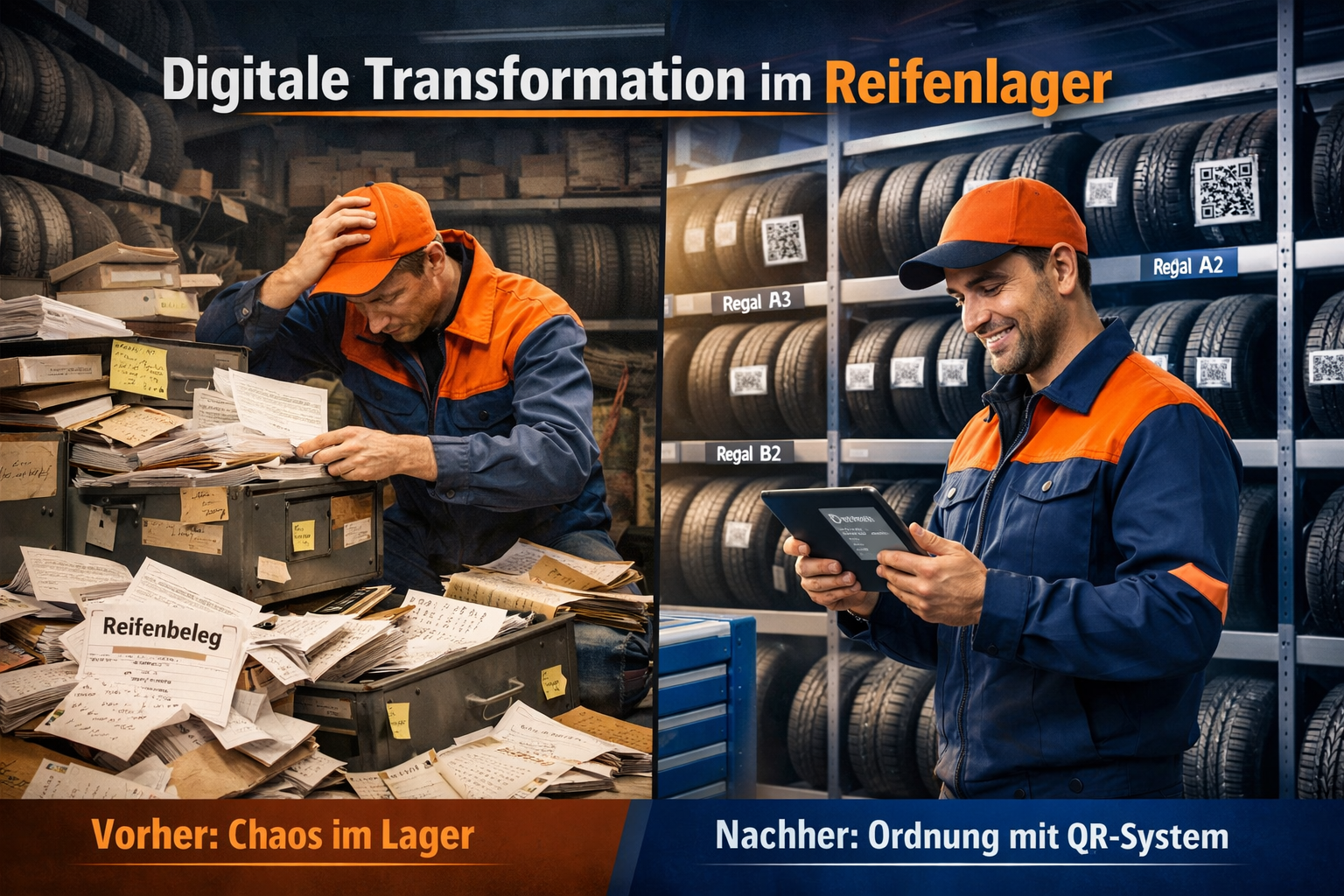
Digital tire inventory management eliminates the chaos during peak seasons through automated customer linking, QR code-based location tracking, and mobile documentation. Modern systems reduce search times by up to 80% and enable better utilization through precise scheduling and capacity management.
Key Takeaways
• Automatic customer assignment eliminates manual searches and drastically reduces sources of error
• QR code tracking enables tire sets to be located in the warehouse in seconds
• Mobile documentation records damage upon storage and provides legally compliant proof
• Integrated scheduling prevents bottlenecks during seasonal changes through intelligent capacity allocation
• Digital work orders link storage data directly to workshop processes
• Automated reminders notify customers in a timely manner before the seasonal change
• Cloud-based systems enable cross-location inventory management across multiple branches
Why Traditional Tire Storage Leads to Chaos
Traditional paper-based tire management reaches its limits, especially during peak seasons. For companies with 1,000 or more sets of tires in storage, manual documentation and filing systems create a significant administrative burden [1].
Common problems with manual administration:
- Lost or damaged storage receipts
- Time-consuming searches through file folders
- Unclear location assignment in the physical warehouse
- Lack of documentation of damage upon storage
- Staff overload during the change of seasons
The result is frustrated customers who have to wait longer for their tires, and stressed-out employees who waste valuable time searching for parts instead of doing productive work in the shop.
Particularly critical: During the peak seasons in spring and fall, these problems escalate exponentially. When hundreds of customers want to have their tires changed at the same time, a minor organizational issue can quickly turn into a crippling bottleneck.
How digital systems enable structured tire storage
Digital tire management systems bring order through systematic data collection and automated processes. The core principle: Each set of tires is assigned a unique digital identity linked to customer data.
Basic functions of modern systems:
- Barcode/QR code generation for every set of tires in stock
- Automatic customer assignment based on vehicle data or customer number
- Digital documentation of damage with photos upon storage
- Location management with precise storage location assignment
- Built-in search function for instant results
The tire management and inventory software for auto repair shops demonstrates how these features can be seamlessly integrated into existing shop workflows.
Practical example: A customer brings in their winter tires for storage. The system automatically records the vehicle information, generates QR codes for the four tires, documents their condition with photos, and assigns an available storage space. The entire process takes less than two minutes.
Key advantage: Data is entered digitally only once during storage; all subsequent processes are automated. This eliminates data entry errors and significantly reduces the workload.
Quick customer lookup via intelligent databases
The automatic linking of tire sets to customer data is at the heart of efficient digital management. Modern systems use various identification features to ensure reliable matching.
Link Methods in Practice:
- Vehicle identification by license plate or VIN
- Linking customer numbers to existing workshop data
- Phone number matching for quick customer identification
- Automatic duplicate detection prevents duplicate entries
Integration with existing vehicle management software, including accounting and workshop management systems, is particularly effective. This ensures that all relevant customer data is immediately available.
Telephony integration for maximum efficiency: Modern systems such as TireSoft3 offer “Phone Connect” features that automatically display customer data on the screen when a call comes in [2]. This enables personalized service and significantly shortens call times.
Common mistake: Many companies underestimate the importance of clean master data. A one-time cleanup of the customer database before system implementation saves a lot of time and frustration down the road.
Optimal capacity utilization during peak seasons
Digital scheduling systems enable a more even distribution of the workload during critical seasonal transitions. Instead of chaotic peak periods, this results in predictable workflows.
Strategies for Better Capacity Planning:
- Scheduling with capacity limits prevents overbooking on specific days
- Automatic appointment suggestions based on available resources
- Early customer communication through automated reminders
- Flexible time slots for different types of services
- Prioritization by customer type or scope of service
This workshop scheduling software for efficient automotive project management seamlessly integrates tire changes into the workshop's overall schedule.
VMI Planning for Precise Deliveries: Suppliers are increasingly turning to VMI (Vendor-Managed Inventory) planning frameworks to ensure timely and accurate tire deliveries during the 2026 peak seasons [2]. This reduces inventory overload and improves predictability.
Helpful tip: Start planning for the season 6–8 weeks before the expected rush. Booking appointments early helps ease the pressure during peak season and offers customers attractive rates for less popular time slots.
Reduced search times through systematic digitization
Eliminating search times is one of the most immediately noticeable benefits of digital tire management. What used to take minutes or even hours can now be done in seconds with modern systems.
Technical solutions:
- QR code scanning for instant identification
- Warehouse mapping with visual representation
- Search filters by customer, vehicle, or tire type
- Mobile apps for warehouse workers on the shop floor
- Real-time inventory overview
Measurable time savings: Businesses report a 70–80% reduction in search times following the implementation of digital systems. With 20 tire changes per day, this translates to a time savings of several hours.
Mobile documentation as a game-changer: Modern systems use mobile scanners for photographic documentation and damage assessment directly at the storage location [1]. This not only ensures legal certainty but also speeds up the entire process.
A common pitfall: The physical warehouse layout must align with the digital structure. A logical numbering system for storage locations is essential for making the most of digital search functions.
Integration into existing workshop processes
Successful digitization of tire storage requires seamless integration into established workshop processes. Isolated, stand-alone solutions create new problems instead of solving existing ones.
Key integration points:
- Work orders with automatic tire data import
- Invoicing, including storage and exchange fees
- Schedule with time slots specific to each tire
- Customer communication across all channels
- Inventory Management for New and Used Tires
For example, TireSoft3 integrates tire inventory data directly into digital work orders, eliminating the need for manual data entry [2]. This reduces errors and speeds up the entire service process.
It is particularly important that the digital document management system centrally record all tire-related documents. From the storage receipt to damage documentation—everything in one place.
Practical tip: Train your team in stages. Start with the basic functionality and gradually introduce more advanced features. This prevents overwhelming your team and ensures acceptance.
Automated customer communications and reminders
Proactive customer communication transforms seasonal peaks from reactive, stressful situations into predictable business opportunities. Automated systems keep customers informed of upcoming appointments in a timely manner.
Communication automation in detail:
- Seasonal reminders 4–6 weeks before the change
- Appointment confirmation with all relevant details
- SMS/email notifications upon completion
- Follow-up actions for missed appointments
- Services such as tire repair
Modern CRM packages are specifically designed for seasonal management and help foster customer loyalty even after all-season tire purchases by sending automated reminders for storage and pickup [2].
Online booking integration: Quick Reifendiscount’s optimized online stores now allow customers to book tire storage and seasonal tire change appointments directly through Google [2]. This integration of digital administrative processes with customer-focused services sets new standards.
Expand payment options: Today, digital tire services support a variety of payment methods, including PayPal, Google Pay, Apple Pay, and Klarna [2]. This simplifies the booking and payment process for seasonal tire services, both online and in-store.
Compliance and Future-Proofing
The digitization of tire storage must also take regulatory requirements into account and be prepared for future developments.
Key compliance considerations:
- Preparing for e-billing in anticipation of the mandatory electronic invoicing requirement effective January 1, 2027
- GDPR-compliant data storage for customer data and vehicle information
- Retention requirements for damage documentation and supporting documents
- Tax Requirements for Invoicing
TireSoft3 has already updated its invoicing functions to meet the e-invoicing requirements that will become mandatory in January 2027 [2]. This ensures that tire dealers’ inventory management systems remain compliant.
Labor shortages as a driving factor: By 2026, the tire and wheel industry will face limited staffing resources and high employee turnover [2]. Digital management systems address these challenges by reducing manual administrative work.
Future-proof architecture: Cloud-based systems offer automatic updates and upgrades without the need for local IT investments. This is particularly important for smaller workshops that do not have their own IT department.
Conclusion
By 2026, digital tire inventory management will no longer be a luxury, but a business necessity. In light of rising labor costs, increasing customer expectations, and regulatory requirements, digital systems offer a decisive competitive advantage.
The key factors for success:
- Systematic implementation with a clear timeline and employee training
- Integration into existing workshop processes rather than isolated, standalone solutions
- Customer benefits through improved service quality and transparency
- Scalability for future growth and new requirements
Businesses that invest in digital tire management now are laying the groundwork for smooth peak seasons and satisfied customers. The technology is mature, the investment pays for itself quickly, and the benefits are immediately apparent.
Next steps: Analyze your current processes, define specific improvement goals, and test suitable systems in practice. Investing in digital organization will pay off as early as next season.
For a comprehensive solution that seamlessly integrates tire management into all workshop processes, CATAMA Automotive Software offers a proven platform with all the necessary features for modern automotive service shops.
References
[1] Eine Runde Sache 2681340 – https://www.autohaus.de/nachrichten/autohandel/eine-runde-sache-2681340
[2] pressebox.de – https://www.pressebox.de/pressemitteilung/gd-handelssysteme-gmbh-koeln/quick-reifendiscount-stellt-sich-den-herausforderungen-2026-mit-know-how-und-etablierten-prozessen/boxid/1288620
