
A down payment—also known as a partial payment or installment invoice—is made by a client when purchasing a service, goods, or a product. In the CATAMA Software Suite, you can generate and settle down payments for orders with a single click in the Invoicing section. Generated installment invoices are automatically applied to the total order value and listed on the final invoice.
Why Clients and Contractors Benefit from Advance Payments
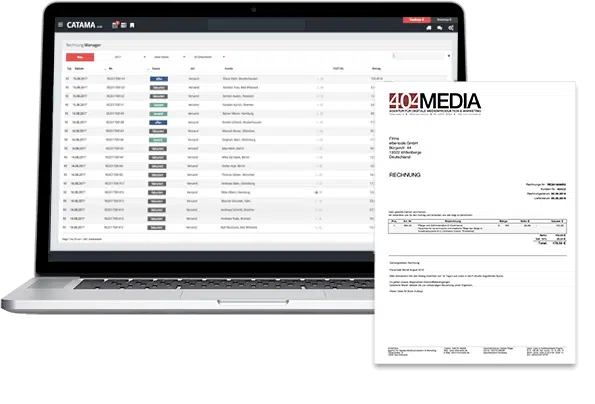 An installment payment or down payment is the payment of a portion of an agreed-upon invoice amount. Installment payments can be useful in many projects. They can help reduce and minimize financial risks for both parties.
When carrying out projects that are financially demanding or time-consuming, the question of how to structure payments often arises. Payment in installments is a fair approach. Instead of receiving a single large final invoice, the contractor can request payment in installments based on the work completed. This practice is common in both the automotive industry and the skilled trades.
By receiving these progress payments, the contractor can pre-finance its services and, if necessary, any upcoming costs for materials and parts. Furthermore, progress payments reduce the financial burden on the client. Finally, progress payments also serve as a motivator for service providers.
To process an interim payment, you can define project phases with subtasks (known as milestones). In CATAMA Project Management, you can quickly create projects of this type. Once a phase of a project is completed, the client is billed for the services rendered and materials used to date.
But be careful: In the skilled trades, among other sectors, the law governing contracts for work and services applies. This law stipulates that the contractor must first perform the agreed-upon work. Only then may payment be demanded. However, if the right to interim payments has not been expressly excluded, the contractor may demand interim payments pursuant to Section 632a(1) of the German Civil Code (BGB).
The following requirements must be met for advance invoices:
- The service provided is/was essentially free of defects
- The services provided are of value to the client
- A summary of the work performed is provided for evaluation purposes.
- The submitted statement clearly indicates which specific services the payment is being requested for.
