
Key Takeaways
• Utilization is the most important metric—it shows how efficiently your shop is operating
• Revenue per job helps you identify profitable customers and optimize pricing
• A parts ratio of 30–40% is crucial for healthy margins in the shop
• Open invoices should be no more than 30 days old—longer payment terms jeopardize cash flow
• Modern software provides all key metrics automatically and in real time
• Data-driven decisions increase workshop success by an average of 15–20%
• CATAMA Software offers comprehensive KPI dashboards for workshop operations
• Regular analyses reveal optimization potential that would otherwise remain undiscovered
Quick Answer
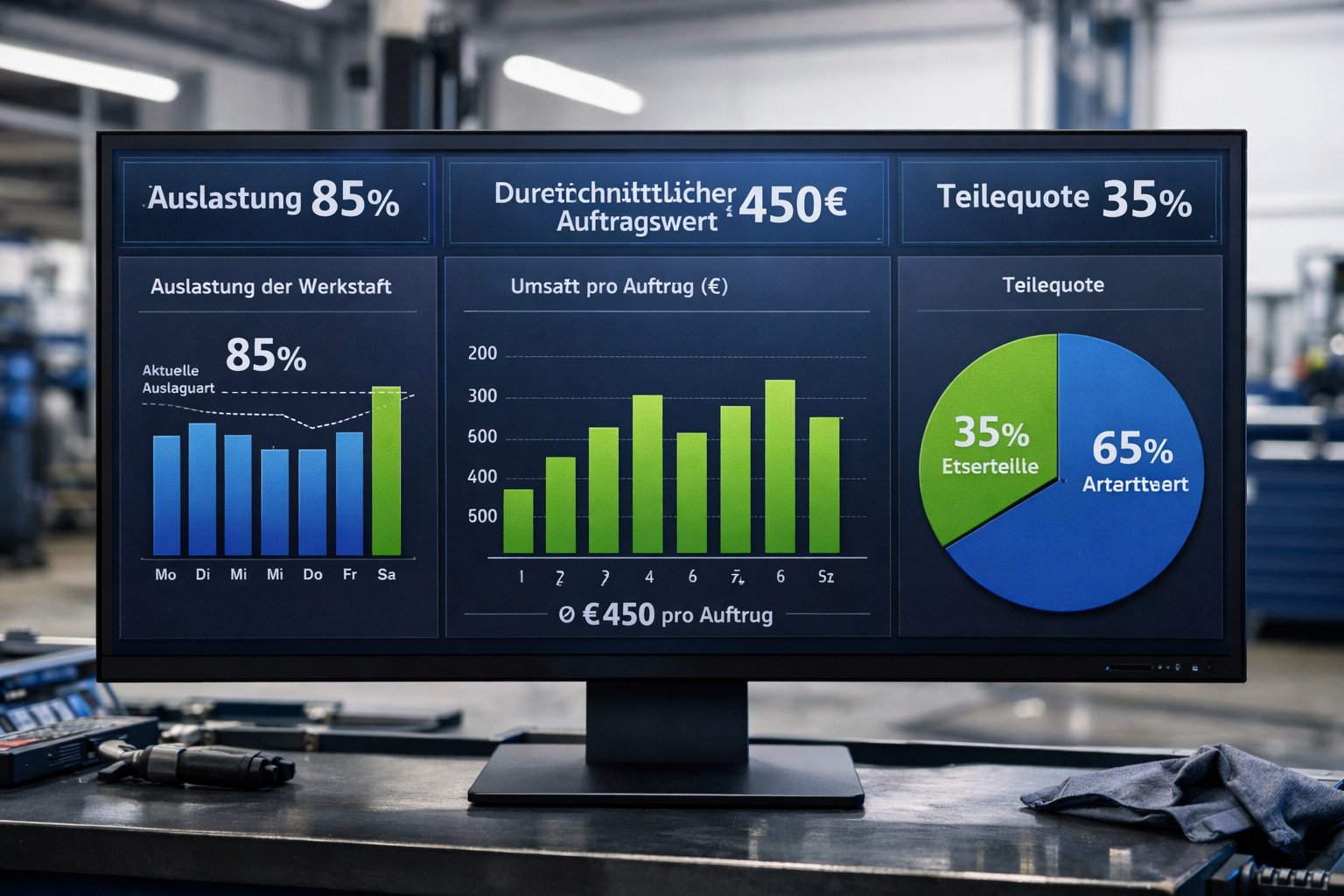
The key performance indicators for auto repair shops are capacity utilization (target: 80–85%), revenue per job, parts ratio (ideal: 30–40%), and outstanding invoices. Modern shop management software like CATAMA automatically generates these figures and enables data-driven decisions that measurably boost success.
Why Key Metrics in the Workshop Determine Success or Failure
Key metrics are the nervous system of your repair shop—without them, you’re driving blind. Modern auto repair shops can no longer rely on gut feelings if they want to operate profitably.
By 2026, successful repair shops will use data-driven decisions to boost their efficiency. Untracked work hours cost repair shops an average of 5–8% of their annual revenue[1]—money that can be recouped through systematic monitoring.
The reality without key metrics: You don't know which orders are truly profitable, whether your employees are working at full capacity, or why cash flow fluctuates. Decisions are based on guesswork rather than facts.
With the right workshop optimization using CATAMA software, you’ll automatically receive all the key metrics—without any manual effort.
The 4 Most Important Key Metrics for Your Workshop
Capacity utilization: The heartbeat of your workshop
Capacity utilization shows you how efficiently your workshop is operating. It is calculated by dividing the actual productive working time by the total available time.
Optimal target: A capacity utilization rate of 80–85% is considered ideal. Higher rates lead to stress and quality issues, while lower rates result in lost profits.
Here's how to calculate capacity utilization:
- Productive work hours ÷ Available work hours × 100
- Example: 32 productive hours ÷ 40 available hours = 80% utilization
Modern workshop scheduling software automatically collects this data and highlights bottlenecks in real time[1].
Revenue per Order: Focus on Profitability
The average order value tells you whether your customers are profitable or whether you're handling too many small repair jobs.
Benchmark values by workshop type:
- Independent repair shops: €280–450 per job
- Authorized dealerships: €380–650 per job
- Specialty repair shops: €450–800 per job
Optimization approaches:
- Actively offer additional services (air conditioning service, tire replacement)
- Develop maintenance packages
- Upselling for Repairs
The CATAMA software automatically analyzes which customers generate the highest order values.
Parts ratio: The profit lever
The parts ratio indicates the proportion of spare parts in total revenue. It is critical to your margin, as parts generate higher profit margins than labor alone.
Target values for healthy margins:
- At least 30% local content
- Ideal: 35–40%
- Over 45%: Check whether enough work is being sold
Common mistakes regarding the parts ratio:
- Markups on replacement parts are too low
- Lack of integration of parts catalogs
- No systematic tracking of small parts
With integrated inventory management systems, every item is automatically recorded and accurately priced.
Open Items: Ensuring Liquidity
Open items show you which invoices have not yet been paid. This metric is crucial for your cash flow planning.
Critical limits:
- Payment terms: up to 30 days
- Over 60 days: Immediate collection proceedings
- Over 90 days: Review debt collection
Automated solutions:
- SMS/email reminders before the due date
- Automated reminder cycles
- Integration with Accounting
The CATAMA accounting integration automatically monitors open items and suggests actions[1].
How software provides you with the numbers at the touch of a button
Modern workshop software eliminates the need to manually collect and calculate key performance indicators. Workshop optimization with CATAMA software takes place fully automatically in the background.
Real-time automatic data collection:
- Every step of the process is recorded in real time
- Partial usage is automatically recorded
- Invoices are immediately included in the analysis
- Incoming payments update the open items
Dashboard features for a quick overview:
- Utilization by employee and lift
- Daily Sales and Order Allocation
- Real-time parts ratio
- List of outstanding items due
The cloud-based solution automatically syncs all data, so you can access up-to-date metrics from anywhere[1].
Mobile time tracking via QR code:
Employees simply scan the QR code on the vehicle to start tracking their time. This eliminates missed entries and ensures accurate utilization data[1].
Make better decisions with analytics
Key metrics alone aren't enough—what matters is what you do with them. Professional workshop ERP software doesn't just provide numbers; it also offers concrete recommendations for action.
Typical optimization scenarios:
When capacity utilization is low (below 75%):
- Check the schedule
- Step up marketing efforts
- Develop additional services
- Partnerships with other companies
If the parts ratio is low (less than 30%):
- Calculate spare part prices
- Expand maintenance offerings
- Train consulting staff
- Promote genuine parts more heavily
If there are a large number of open items:
- Update payment terms
- Check creditworthiness before accepting an order
- Implement automatic collection procedures
- Prepayment for new customers
CATAMA Software's intelligent scheduling feature automatically identifies available capacity and suggests optimal scheduling options[1].
AI-powered forecasts for 2026:
Artificial intelligence analyzes historical data and predicts the time required for similar repairs. This significantly improves scheduling and cost estimates[1].
FAQ
Which metric is the most important for auto repair shops?
Capacity utilization is the most important metric because it directly shows how efficiently your shop is operating. Without sufficient capacity utilization, even other positive metrics cannot guarantee success.
How often should I review my workshop metrics?
Daily for operational metrics such as capacity utilization and open items, weekly for revenue per order, and monthly for strategic analyses such as trends in the parts ratio.
What is a good parts ratio for independent repair shops?
A parts ratio of 30–40% is considered optimal. A ratio below 25% suggests that spare parts prices are too low, while a ratio above 45% could mean that not enough labor is being sold.
Can I track key metrics without expensive software?
Basic metrics can be tracked using Excel, but the effort involved is enormous and prone to errors. Modern software usually pays for itself within a few months through time savings and better decision-making.
How can I quickly improve my utilization rate?
Reduce scheduling gaps through flexible planning, offer express services, use wait times for minor repairs, and improve communication between the front desk and the workshop.
What are realistic target figures for revenue per job?
That depends on your area of specialization. Independent repair shops should aim for at least €300, while brand-authorized repair shops should aim for €400–500. Continuous growth is more important than absolute figures.
How long can outstanding invoices remain unpaid?
A maximum of 30 days for residential customers; for business customers, it depends on the agreement. Any amount outstanding for more than 60 days jeopardizes liquidity and should be consistently followed up with reminders.
Which metrics indicate which customers are profitable?
High revenue per order, short payment terms, regular orders, and a low complaint rate. CATAMA Software automatically generates customer profitability analyses.
How can I identify areas for improvement in the numbers?
Compare your figures with industry averages and analyze trends over several months. Sudden changes or a steady decline indicate a need for action.
Can software really capture all key metrics automatically?
Modern ERP systems like CATAMA capture 95% of all relevant data automatically. Only strategic assessments and interpretations remain the responsibility of the workshop manager.
How much does professional workshop software cost?
The investment usually pays for itself within 3–6 months thanks to time savings and better decision-making. Free trial periods allow for a risk-free evaluation.
How secure is my data in the cloud?
Reputable providers like CATAMA use German data centers that meet the highest security standards. Data security is often better than with local servers in the workshop.
Conclusion
By 2026, key performance indicators will no longer be optional—they’ll be crucial to a repair shop’s success. The four most important metrics—capacity utilization, revenue per job, parts ratio, and open items—put you back in control of your business.
Modern workshop optimization with CATAMA software makes tracking and analyzing these metrics a breeze. Instead of spending hours collecting data, you can access all the key information at the touch of a button.
Your next steps:
- Define your current target metrics
- Try professional workshop software free for 30 days
- Implement automatic evaluations
- Make decisions based on real data rather than gut feelings
The difference between successful and average repair shops isn't their size or equipment—it's how systematically they use their data. Start optimizing your repair shop with data today.
References
[1] The Workshop Planner for Auto Repair Shops: Efficient Workshop Planning in 2026 – https://www.catama-software.de/features/der-werkstattplaner-fuer-kfz-werkstaetten-effiziente-werkstattplanung-im-jahr-2026/
